

Who Lives on Comino? The Last Residents of Malta’s Most Beautiful Island
Every summer, hundreds of thousands of people visit Comino. They come for the Blue Lagoon, for the Crystal Lagoon, for the sea caves and the extraordinary turquoise water. They photograph it, swim in it, and carry its image home with them to share with people who haven’t yet been.
Almost none of them know that someone lives there.
Not a hotel caretaker. Not a seasonal worker. A permanent resident — a man who was brought to Comino when he was one week old, in 1951, and has been there every single day since.
His name is Salvu Vella. And his story is one of the most remarkable in the entire Maltese archipelago.
Who Lives on Comino Today — 2026
Comino has no roads in the conventional sense. No cars. No supermarket. No hospital. No school. No bank. No ATM.
What it has is Salvu Vella — born in 1951, now in his mid-seventies, and still the permanent full-time resident of an island that in peak summer hosts thousands of visitors a day and in winter hosts almost none.
His cousin Veggie — Evangelista Buttigieg — still spends time on the island, though at her age she divides her time between Comino and Gozo island, returning to family when she needs help or medical attention.
Two other members of the extended family who were part of Comino’s small community for decades are no longer with us. Marija, Salvu’s aunt, has passed away. Anglu Vella, Salvu’s brother — a fisherman, a gardener, a Water Services fitter, and a lifelong companion on the island — has also died. Their loss has left a quieter Comino, but not an empty one.
Salvu remains.
A Life That Began Before the First Week Was Out
Salvu’s mother left Comino briefly in 1951 — travelling to St Paul’s Bay on the main island of Malta so that a midwife could assist with the birth. One week later, she returned to Comino with the newborn Salvu.
He has never really left since.
The family’s connection to Comino goes back further still — to 1926, when Salvu’s grandfather Pawlu Said was brought to the island by Captain Arthur Zammit Cutajar, whose company had been granted a lease to develop horticulture on Comino. Grandparents, parents, and then Salvu himself — three generations anchored to this tiny island between Gozo and Malta.
He grew up in the Palace and Isolation Hospital complex — a building dating to the 17th century, built by Grand Master Alof de Wignacourt. The family of eight lived in a unit measuring roughly 15 feet by 15 feet. Below them was the family shop, opened in 1927, selling tinned food, flour, salt, and basic goods to the small island community.
Salvu was educated at the school located in the same complex — a school opened in 1929 to serve the children of the farm workers who kept Comino’s horticulture business alive. He was the last pupil when it finally closed in 1964-65. The classroom is still there today.
The Remarkable Mind of Salvu Vella

Salvu with our skipper Justin, in his solar buggy
If you want to understand Salvu Vella, start not with the romance of island life but with his mechamical genius
He was a child when he first took a broken bicycle apart and made it work again. But perhaps the story that best captures who he is comes from his early teens. Somewhere on Comino he got his hands on a walk-behind rotary tiller — the kind of engine-driven tool used for turning soil. He attached it to a two-wheeled cart that had almost certainly been built for a horse or a mule. Nobody had told him this was possible. Nobody had shown him how. He simply looked at what he had, understood what it could do, and built himself a vehicle. And just like that — a teenage boy on a tiny island with no roads, no cars, and no garage — had something that could carry him and his friends from one end of Comino to the other. The island was his, in a way it had never quite been before.
He was a child when he first took a broken bicycle apart and made it work again. By the age of 20 he had converted his father’s petrol-driven car to run on gas — an achievement that alarmed his relatives and delighted him. He stripped boat engines, reset their points, and rebuilt them from components that by rights should have been scrap. He built a frejgatina from plywood with his father. He then built a 28-foot wooden schooner fitted with a diesel engine.
Salvu is, by any measure, a self-taught genius.
His most celebrated invention is a remote-controlled boat trailer — a device he built himself that allows him to remotely drive his trailer, with his power fishing boat loaded on it, all the way down the Santa Marija Bay slipway and into the water. The trailer then manoeuvres itself back up to a parking position. When Salvu returns from fishing, he calls it back remotely to collect him. A piece of engineering that many a trained mechanical engineer would struggle to conceive, let alone build — designed and built on a tiny island by a man who taught himself everything he knows.
He has built boats. He is building a hovercraft. He has created solar-powered irrigation systems for his crops — buying the panels and tracker, then building every other component himself. He maintains a bobcat, both of which he is perpetually improving, fixing, and adapting for teh comino life.
And he didn’t stop there. Over the years Salvu has converted multiple quad bikes and cars from petrol engines to electric power — and in some cases beyond that, to run entirely on solar energy. On an island with no petrol station, no garage, and no mechanic within easy reach, the ability to engineer your own solutions is not a hobby. It is a necessity. For Salvu, it became something more — a quiet, ongoing demonstration that the most innovative thinking sometimes happens furthest from the places where innovation is supposed to occur.
Then there are the drones.
Salvu’s drone footage of Comino — taken from above the Blue Lagoon, above the Tower, above the feast day celebrations in the Palace quadrangle — captures his island in a way that decades of tourist photography from sea level never quite has. He sees Comino differently from the air. He has always seen it differently from everyone else.
Daily Life on Comino — What It Actually Looks Like
For decades, Salvu and Anglu worked the land around their house — organic vegetables, fruit, a small amount of produce that supplemented what they caught and what they grew. Onions, garlic, potatoes, tomatoes. Cherries plums so good that, as Salvu once put it, it made more sense to eat them than sell them.
The land around the house and the Palace is changing now. With fewer hands to tend it, more of it has returned to wild garigue — the low scrubland of wild thyme and herbs that gave Comino its name. Kemmuna: the island of cumin. Walk across Comino in spring and you can still smell it.
But the island itself has also been changing in a different way. In the years since 2016, the Maltese government has invested significantly in Comino — including an extensive reforestation programme, planting pine trees, carob, olive trees, and more across the island. What was increasingly bare limestone is gradually becoming green again. It is a change that would have pleased the people who lived through the years when Comino’s trees and vegetation were at their most abundant.
The Blue Lagoon has been reorganised too — new paths, the deck chairs reduced and pushed back from part of the shore, more beach returned to the water. More structured than it was a decade ago. More organised.
Salvu’s world continues around all of it. His free-range chickens still roam. The peacocks are still there — you might hear them before you see them on a quiet morning. The wild rabbits that he reintroduced over decades, and which he speaks of as pets rather than livestock, still move through the island’s vegetation.
He has kept bees for decades — maintaining hives on the island and producing honey that, in the years when Comino’s wild thyme was at its most abundant, was considered exceptional. He tends his colonies still. But in recent years a new challenge has arrived that no amount of engineering ingenuity can easily solve — the Asian hornet, which has taken a significant toll on bee colonies across Malta and the wider Mediterranean. Salvu watches his hives carefully, as he always has. The bees are still there. So is he.
He has also been a serious fisherman for most of his life — not casual shore fishing but proper, skilled, seasonal work on open water. He fished many seasons for mahi mahi — lampuki — one of the most prized catches in Maltese waters, targeted during their autumn migration through the channel. He worked trammel nets, requiring knowledge of the seabed, the currents, and the movement of fish that only comes from years on the same stretch of water. He fished by longlining — setting lines for tuna and swordfish in deeper water. He still goes out from the Santa Marija Bay slipway when conditions are right, reading the same water his father taught him, in the same channel his family has fished for a century.
He still works on his inventions. He still flies his drones over the island every morning and every evening.
The Family That Built Comino’s Modern History
The Vella family’s presence on Comino over the past century amounts to something extraordinary — not just in terms of their own lives, but in what they did for the island itself.
Salvu and Anglu worked at the hotel at Santa Marija Bay from their teenage years — Salvu in the kitchen and then maintaining the boats, Anglu tending the gardens. Salvu’s reputation for fixing engines and mechanical equipment grew quickly. He was so good at it that even when a boat was sent to Malta to be repaired by professional mechanics — and came back still broken — the hotel would call Salvu. He would go out, find the problem, and fix it. On a small island, word travels fast. Everyone knew that if something was broken and nobody else could fix it, Salvu could.
The Family That Built Comino’s Modern History
The Vella family has been part of Comino for nearly a century. They were here when the island was a working farm. They were here when the hotel opened. They were here when the first tourists discovered the Blue Lagoon. And they are still here now.
Salvu and his brother Anglu both worked at the hotel in Santa Marija Bay from their teenage years. Salvu started in the kitchen, washing dishes and carrying out basic tasks. But his talent for fixing things quickly became obvious. He moved on to maintaining the hotel’s boats and vehicles — and became so trusted that even when a boat was sent to Malta to be repaired by professionals and came back still broken, the hotel called Salvu. He went out, found the problem, and fixed it. Simple as that.
Anglu worked in the hotel gardens. He was also a professional fisherman — going out regularly and selling his catch to the hotel. He understood the sea around Comino the way most people understand their own street.
Both brothers later worked for the Water Services — drilling and maintaining bore holes across the island, keeping the water supply running. Between them, they knew the physical structure of Comino better than anyone. Where the fresh water sat underground. Where the salt water crept in. Which pumps needed watching and which wells ran deep.
Anglu worked for the Water Services until he retired in 2008 and 2009. His loss leaves a gap that simply cannot be filled.
Marija and Veggie were the heart of the family’s home life for decades.
Marija worked in the small island shop — opened by the Cutajar family in 1927 — selling tinned food, flour, salt, sweets, and basic supplies to everyone on Comino, including soldiers stationed on the island during World War II. The shop ran for over 70 years before it finally closed as the population shrank.
Both women were known as outstanding cooks. Veggie kept the household running for years. Together, the two of them tended a small vegetable plot behind the Palace — the same building where the Vella family had lived and gone to school — long after the school itself had closed.
Marija lived to a great age. She carried memories of Comino that nobody else alive can share. As a girl of 15, she stood on the shore of San Niklaw Bay on a stormy day and attended a mass held across the water. The weather was too rough for the priest to cross from Gozo — so he stood on the Gozo shore, and the residents stood on the Comino shore, and the two groups communicated using flags raised in a specific order. A mass conducted across the sea, between two rocky shores, using nothing but coloured flags and timing.
She remembered that day for the rest of her life.
The History They Carry
The Vella family has lived through every chapter of modern Comino history.
They worked the land during the horticulture years under the Cutajar company. They went to the island school — opened in 1929, closed in 1965. They worked at the hotel. They maintained the pig farm — a short-lived but important project where Comino bred disease-free pigs after swine fever wiped out the entire pig population of Malta. They watched the Blue Lagoon go from a quiet spot known mainly to Royal Navy families to one of the most visited places in the entire Mediterranean.
The buildings around them carry the same history.
The Palace where they grew up was built in the 17th century. The Isolation Hospital beside it was built by the British in the 1890s — originally for patients with cholera and plague, later used to treat soldiers wounded in the Dardanelles campaign during World War I. If you look carefully at the back wall of that building today, you can still see the marks left by machine gun fire from a plane that dive-bombed the complex during World War II.
The chapel where Salvu still helps the priest at mass was first recorded in 1296 — over 700 years ago.
These are not just old buildings. For the Vella family, they are home.
Getting Supplies — How Life Works on an Island With No Shop
There is no shop on Comino. The last one closed long ago. So how does Salvu get what he needs?
The answer is simple: relationships and planning.
The Comino ferry — which runs passenger services between Mġarr Harbour in Gozo and the Blue Lagoon — helps bring supplies across to Salvu when they can. So do the employees of Snack Box, one of the kiosk operators at the Blue Lagoon. These are practical arrangements built on years of goodwill and neighbourly kindness — the kind of thing that happens naturally on a small island where everyone knows everyone.
For many decades, Dun Karm Xerri
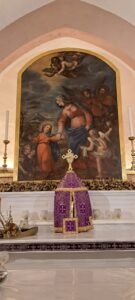
Comino Chapple altar
— Father Carmelo Xerri — was one of the most important people in Salvu’s life. He had been travelling to Comino since 1963 to hold mass at the Santa Marija Chapel, and for all those years he brought medicine, food, and other essentials with him from Qala in Gozo. He did this for nearly 60 years without fail. Salvu called him “a real father” — and it is easy to understand why. Sadly, Dun Karm Xerri passed away in January 2021, just weeks after Anglu. Two losses, in two months, for a man living alone on a small island.
Today, the chapel and its community are in the care of a new chaplain — Dun Ġużeppi Attard.
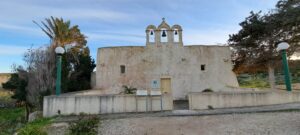
Santa Marija Chapple
He continues the tradition, organising the mass every Sunday and keeping the Comino feast alive as an annual celebration. The chapel that has been in use since 1296 continues — and Salvu continues with it.
Water used to be drawn from bore holes drilled across the island — some as deep as 105 feet. Fresh water sat near the surface; go too deep and the water turned salty as the sea crept in. Salvu learned all of this from working with his brother for the Water Services. Today, water is piped across from Malta via Gozo.
For everything else, Salvu works it out. He grows his own food. He catches his own fish. He builds and fixes what he needs. Living on a small island with no services teaches you very quickly how to be resourceful. For Salvu, that resourcefulness became a way of life — and then an art form.
Comino in Winter

santa marija comino in the winter
Comino in summer is loud, bright, and full of people. Comino in winter is something else entirely.
The ferries slow down. The food trucks are gone. The deck chairs are packed away. The Blue Lagoon — which in peak August can see over 4,000 visitors in a single day — becomes almost silent. The water is just as blue. The cliffs are just as dramatic. But there is nobody there to see them except the birds, the rabbits, and Salvu.
He is always there in winter. The chickens need to be fed every day. The bees need checking. The boats need maintenance. The solar systems need adjusting. His inventions are always in progress — a new idea, a broken part, something being improved. Winter is not a quiet time for Salvu. It is just a different kind of busy.
On winter Sundays, mass is still held at the Santa Marija Chapel. One of the oldest churches in the Maltese islands — first recorded in the year 1296. Salvu still helps at the vestry, as he has done his whole life. In winter the congregation is sometimes very small. Sometimes it is just the remaining residents and the priest who has been making the crossing from Gozo for over 60 years.
It is a simple image — a small chapel, an old priest, a man in his mid-seventies who has lived on this island since he was one week old. But there is something about it that stays with you.
The Island He Has Always Known
Salvu Vella did not stay on Comino because he had no choice. He is a gifted engineer and inventor. He could have worked anywhere. He stayed because Comino is his home — and because he loves it.
He loves the birds. He introduced starlings, quails, pheasants, partridges, and doves to the island over the years — hatching eggs, building nesting boxes, and watching populations slowly grow. He loves the sea. He has fished its channels for decades — lampuki, tuna, swordfish — reading the water the way his father taught him. He loves the engineering problems that come with island life, and the satisfaction of solving them in ways nobody has thought of before.
And he loves seeing his island from above. His drone footage of Comino — the Blue Lagoon, the Tower, the feast day celebrations in the Palace quadrangle — shows the island the way very few people ever see it. From up there, you can see everything at once. The beaches, the caves, the fields, the chapel. The whole of the world he has known since before he could walk.
Tourists arrive in summer, spend their day in the blue water, and go home. Salvu is there when they arrive and there when they leave. He was there before most of them were born.
Comino, in every sense that matters, is his island.
Come and See It for Yourself
Every private boat tour we run around Comino passes through waters that Salvu Vella has known his entire life. The caves, the coves, the reef at Cominotto, the cliffs of Santa Marija Bay — all of it is part of the island his family has called home for nearly a hundred years.
If you visit by private boat, you might see the slipway at Santa Marija Bay where Salvu launches his fishing boat. You might see the Palace — its walls still standing after 400 years — where eight members of the Vella family once lived in a single small room. You might see the chapel where mass has been said since 1296.
And if you are lucky, you might catch a glimpse of a man flying a drone. Or driving a bobcat along a track. Or heading out to sea in a small boat on a calm morning, doing exactly what his family has always done on this island.
Book a private Comino boat tour here. For the complete Comino guide, read here. For the best things to do on Comino by private boat, read here. For the history of Comino — pirates, Knights, towers and more — read here.
FAQ — Who Lives on Comino Malta?
How many people live on Comino Malta?
As of 2026, one person lives permanently on Comino — Salvu Vella, who has been on the island since he was one week old in 1951. His cousin Veggie spends time on the island when she is able to.
Who is Salvu Vella?
Salvu Vella is the permanent resident of Comino. He is a self-taught engineer, inventor, organic farmer, fisherman, beekeeper, and drone enthusiast. His family first came to Comino in 1926. He has lived there his entire life and is widely regarded as the island’s custodian.
Has Comino always had people living on it?
The population of Comino has gone up and down throughout history. There were around 150 residents in 1799, just 33 in 1881, and 77 in 1946. The Vella family has been one of the most constant presences on the island for the past hundred years.
What does Salvu eat — is there food on Comino?
Salvu grows his own organic vegetables including onions, garlic, potatoes, and tomatoes. He also fishes regularly — catching lampuki, tuna, and swordfish from the waters around the island. The family has always aimed to be as self-sufficient as possible.
Is there a shop on Comino?
No. The last shop on Comino — run by the Cutajar family from 1927 — closed many decades ago. Supplies are brought across by boat from Gozo.
Can you stay overnight on Comino?
The Comino Hotel at Santa Marija Bay is currently closed for renovation. There is a designated camping area on the island. Most visitors arrive by day trip ferry or private boat and return to Malta or Gozo in the evening. 🚤
Further Reading
- Comino Island Malta — Complete Guide 2026
- The History of Comino — Pirates, Prisons and Power
- Best Things To Do on Comino 2026
- Santa Marija Bay Comino — Complete Guide
- Comino Tower — Saint Mary’s Tower
- Salvu — One of the Last Comino Residents
- Comino Sea Caves — Complete Guide
- Blue Lagoon Malta — Complete Guide 2026
- Comino and Cominotto Guide
- Private Boat Tour Malta — Complete Guide