

Comino Island Malta — The Complete Guide 2026 (Everything You Need to Know)
Most people who visit Comino see about 10% of it.
They arrive by ferry, find a spot on the Blue Lagoon beach, spend three hours there, and go home. They tell everyone the Blue Lagoon was beautiful — and they are right. But they missed the hidden sandy beach inside a 40-metre cave. They missed the tiny uninhabited island directly across the water with a private lagoon inside a cave. The medieval tower that has watched over the island since 1618. Or the man who has lived on Comino for decades, growing his own vegetables, fishing his own fish, and watching the entire world change around him while the island stays exactly the same.
 This guide is for the people who want all of it — not just the lagoon.
It is written by a team that has been running private boat tours around Comino since 2016. We are there every day. What follows is everything we know — the history, the caves, the bays, the marine life, the hidden spots, the practical information, and the local knowledge that no other Comino guide has.
Comino Island Malta — Quick Facts 2026
| Location | Between Malta and Gozo, Maltese archipelago |
| Size | 2.8 square kilometres |
| Coastline | 9.5 kilometres |
| Population | 1 permanent resident (Salvu Vella) |
| Beach type | Partially sandy, partially rocky |
| Can you swim? | Yes — respect the safety flags at all times |
| Water temperature | 16.4°C (Feb) to 28°C (Aug) |
| Best time to visit | September — warm water, fewer crowds |
| Busiest months | July and August |
| Blue Lagoon entrance | Free — but access pass required to go ashore |
| Access pass | Free — register at www.blcomino.com |
| Time slots | 08:00–13:00 / 13:30–17:30 / 17:30–22:00 |
| Lifeguards | Year-round from 2026, 08:00–18:00 |
| Sun loungers | ~200 available — gone by 10:30am in peak season |
| Umbrellas | ~100 available — gone by 10:30am in peak season |
| Food | Kiosks on site — burger €8, wrap €7.50, hot dog €6 |
| Pineapple cocktail | €10 with alcohol / €8 virgin |
| Cash or card? | Cash strongly recommended |
| Where to stay | Campsite at Santa Marija Bay — only legal camping on the island |
| Hotel | Former Comino Hotel converting to Six Senses — opening 2026/2027 |
| How long do you need? | Minimum half a day — full day to see Blue Lagoon and Santa Marija Bay |
| Private boat journey time | 10–15 minutes from Cirkewwa |
| Ferry journey time | 20–25 minutes from Cirkewwa |
| Ferry price | €15 adult / €7 child under 9 |
| Sea caves | 6 main caves — accessible by private boat only |
| Best cliff diving | Crystal Lagoon — most variety of heights |
| Permanent residents | 1 (Salvu Vella) |
| Protected status | Natura 2000 site |
| Getting there | Private boat, ferry, jet ski safari, group tour, kayak (Gozo only) |
What Is Comino Island?
Comino is the third island of the Maltese archipelago — the small one between Malta and Gozo that most people fly over without noticing. It sits roughly halfway between Cirkewwa in the north of Malta and Mġarr Harbour in Gozo, occupying approximately 2.8 square kilometres of the central Mediterranean.
Despite its size, Comino is one of the most extraordinary natural environments in the entire Mediterranean. The coastline stretches over 9.5 kilometres and includes soaring cliffs on the eastern side, sandy inlets in the north, hidden sea caves around every headland, and the extraordinary turquoise bay that has become one of the most photographed places in Europe.
The island is part of the Natura 2000 network — one of the EU’s most important designations for protected natural habitats. Consequently, development on Comino is almost entirely prohibited, and the island remains essentially as wild and undeveloped as it has always been.
Directly to the west of Comino, separated by a channel of approximately 125 metres, sits Cominotto — a tiny island of about 0.25 square kilometres that forms the other side of the famous Blue Lagoon. Between the two islands lies some of the most vivid turquoise water in the world.
The Name — What Does Comino Mean?
The island has collected names across the centuries the way limestone collects the sea — each one a reflection of who was passing through and when.
The ancient Greek navigator Scillace referred to it as Lampas — meaning “meteoric” or “torch-like,” perhaps a reference to how the limestone cliffs glow in afternoon Mediterranean light.
Ptolemy, the 2nd-century Greek geographer, listed it as Chemmona. The Roman geographer Cluverius used Kemunian. Later Arabic-influenced naming produced Ghemewnet.
The current name — Comino in English and Kemmuna in Maltese — is almost certainly derived from the cumin plant (Cuminum cyminum), which historically grew in abundance on the island. The spice has been traded throughout the Mediterranean for thousands of years, and Comino’s position on the sea routes between North Africa, Sicily, and the eastern Mediterranean made it a natural waypoint for that trade.
Cominotto — the tiny island to the west — takes its name as a diminutive of Comino. Little Comino. The smaller sibling.
Comino Through History — 7,000 Years in the Mediterranean
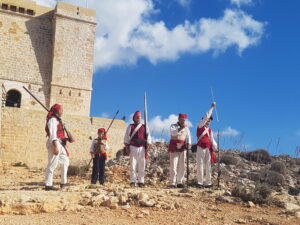
comino tower reenactment
The Earliest Evidence — Phoenicians and Romans
Comino may be quiet today, but beneath its rocky soil lies a timeline that stretches back thousands of years. The island was never heavily inhabited — its lack of reliable fresh water made permanent settlement difficult — but it was known, visited, and used across many centuries.
The Maltese historian Giovanni Francesco Abela, writing in 1630, recorded the discovery of lead amphorae and earthenware pipes on Comino — containers likely used to store and transport water, suggesting the island served as a waypoint for vessels crossing the central Mediterranean.
A decade later, in 1640, an earthenware sarcophagus was discovered in Wied Ernu on Comino. Experts attribute it to a Phoenician settler — part of the seafaring civilisation that dominated Mediterranean trade from their base in modern-day Lebanon and Tunisia. The Phoenicians were the great maritime explorers of the ancient world, and their presence on Comino reflects the island’s position on their trade routes.
Perhaps the most remarkable find came in 1912, when workers digging near Qala Santa Marija unearthed a large earthen jar. Inside was the skeleton of a man from the 3rd century BC, carefully placed between two halves of an amphora, along with oil lamps and ointment phials. These artefacts — now housed in the Archaeological Museum at the Cittadella in Gozo — offer a rare and intimate glimpse of ancient life on this small island.
The Medieval Period — Knights, Corsairs, and Invasion
The medieval history of Comino is turbulent. The island’s position between Malta and Gozo made it both strategically valuable and militarily vulnerable — a place that empires fought over, pirates sheltered in, and ordinary people occasionally tried to farm.
During the medieval period, Comino was used intermittently for agriculture. The Knights of St John — who took control of Malta and Gozo in 1530 — recognised the island’s importance and attempted to regulate both its use and its security.
The most devastating episode in Comino’s medieval history came in 1551, when Ottoman forces led by the corsair Dragut launched a devastating raid on Gozo and the surrounding islands. The entire population of Gozo — approximately 5,000 people — was enslaved. Comino, with its small and scattered population, suffered similarly. The raid was one of the most catastrophic events in Maltese history, and its effects were felt for generations.
Saint Mary’s Tower — Built to Prevent Another 1551
The response to the 1551 raid came slowly but eventually resulted in one of Comino’s most enduring landmarks. Saint Mary’s Tower — also known as the Comino Tower — was constructed between 1618 and 1620 under the authority of Grand Master Alof de Wignacourt.
The tower was built as part of a coastal watch system designed to provide early warning of approaching vessels — particularly Ottoman warships and Barbary corsairs who continued to threaten the Maltese islands throughout the 17th century. It stands at the highest point of Comino’s coast near the Blue Lagoon, and on a clear day the views from its roof stretch across to both Malta and Gozo.
The Architecture — Built to Withstand an Empire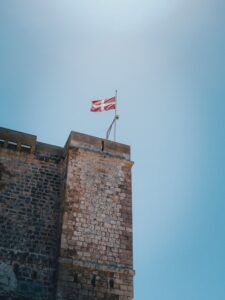
The tower is circular in plan, approximately 9 metres in diameter and 14 metres high. It is constructed of the same golden limestone that forms the island itself. Architecturally, it belongs to the same tradition as the coastal watch towers built across Malta and Gozo during the same period — simple, functional, and extraordinarily durable.
Here is the detail that surprises almost every visitor: despite its impressive external scale, the interior of Saint Mary’s Tower consists of only a handful of small rooms. The reason is the walls. Some sections are over 20 feet thick — built to withstand direct cannon fire from Barbary pirate and Ottoman warships. The thickness of the walls that protected the soldiers inside is the same reason there is almost no usable space within them. The Knights built for survival, not comfort.
The 400-Year-Old Toilet
To the right-hand side of the main entrance door, there is a carved recess in the wall — a small seat, and a hole where a bucket would have been placed. This is a 400-year-old toilet, used by the soldier who stood guard on the outer plinth of the tower.
It is one of those small, completely human details that makes history feel genuinely close. A man standing watch on a remote island, looking out for Ottoman sails on the horizon — and when nature called, using this carved stone niche with a bucket below. The soldier and the bucket and the door are long gone. The carved recess is still there, exactly as it was built, four centuries later.
The Restoration — Reopening in 2026
Saint Mary’s Tower has been undergoing significant restoration work for the past two years. The scaffolding that has surrounded the tower during this period is now in its final phase — and by 2026 the restoration will be complete, the scaffolding will come down, and the tower will reopen to the public.
Today, Saint Mary’s Tower is managed by volunteers from Wirt Għawdex and is open on certain days when the Knights’ flag flies above it. From the tower’s roof, the view across the Blue Lagoon and out to sea gives you an immediate understanding of why this particular spot was chosen for the island’s watchtower.
💡 Local Tip: If you see the flag of the Knights flying from Saint Mary’s Tower, the tower is open. Walk up from the Blue Lagoon — the path takes approximately 15 minutes. The views from the roof are extraordinary and the visit is free. When you arrive, look for the carved recess to the right of the main door — the 400-year-old soldier’s toilet is one of the most genuinely fascinating small details on the island. On days when the tower is closed, the walk to the base is still worth doing for the coastal views.
The Battery at Santa Marija Bay
Less visited than the tower but equally interesting is the Santa Marija Battery on Comino’s southern coast — a small fortification built by the Knights in the late 17th century to complement the coastal watch tower. The battery sits on a headland above Santa Marija Bay and is significantly harder to find than the tower, which is precisely why most visitors never see it.
The battery reflects the continuing military anxiety of the Knights throughout this period. Even decades after the Great Siege of 1565 and the construction of the coastal watchtowers, the threat of Ottoman and Barbary corsair raids remained real. The battery was one element of an integrated coastal defence system that covered the approaches to both Malta and Gozo.
The Restoration — A Gozitan Master Mason’s Work
The Santa Marija Battery has been carefully restored — the work carried out by a Gozitan master mason named Sultana, known locally as Bufajra. The restoration preserved the original character of the fortification while stabilising the structure against further deterioration. It is the kind of careful, skilled, unhurried stonework that the Maltese islands have always produced — and the battery stands today as a testament to both the Knights who built it and the craftsman who brought it back.
The Cannons
Perhaps the most striking detail at the Santa Marija Battery: four of the original six cannons are still in place. Standing on that remote headland above Santa Marija Bay, looking out across the water with the original cannon barrels pointed toward the sea approaches — it is one of the most genuinely atmospheric military history experiences available in the Maltese islands. The fact that almost nobody finds this place makes it even more remarkable.
💡 Local Tip: The Santa Marija Battery is genuinely hard to find — it is not signposted and not on most tourist maps. Ask your skipper or a local before you go. The walk from Santa Marija Bay to the battery headland is short but requires leaving the main path. The four surviving cannons and the restored stonework are worth every minute of the effort. Go early in the morning before the heat builds.
Comino in the 20th Century — The Hotel and the Quarantine
The 20th century brought a different kind of activity to Comino. In the early 1900s, the island was used as a quarantine station — a place where ships arriving in Maltese waters that might be carrying disease were required to anchor and wait before their passengers were permitted to disembark. The remoteness of Comino made it ideal for this purpose.
Later in the century, the Comino Hotel was built at San Niklaw Bay — a hotel and bungalow complex that for several decades provided the only formal accommodation on the island. The hotel attracted visitors seeking a genuinely remote Mediterranean experience — no cars, no roads, no town, just the island and the sea.
The Comino Hotel closed in recent years for refurbishment. As of 2026, planning permits have been approved and construction is scheduled to begin in May 2026. The hotel is being converted into a Six Senses resort — one of the world’s leading luxury hotel brands. When complete, it will represent one of the most remarkable hotel openings in the Mediterranean.
Does Anyone Live on Comino?
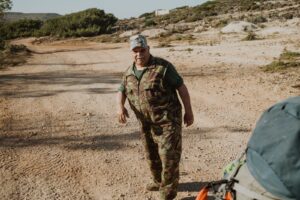
Comino Salvu
A Community That Once Existed — The Population Through the Centuries
It is easy to look at Comino today and assume it was always this empty. It was not.
In the early 1900s, approximately 60 people lived permanently on Comino — a genuine, functioning island community made up of multiple families. The population was notably young — the island had many children — but as those children grew into adults, the pull of the mainland and the wider world proved too strong. Most left for Malta or Gozo when they came of age. Many went further — emigrating to Australia, which received a significant wave of Maltese emigrants throughout the early and mid-20th century. Comino’s young people were part of that broader story of Maltese emigration, choosing opportunity over the extraordinary but demanding life of a small island.
By the 1960s, around 40 people still called Comino home — a reduced but still functioning community, made up of several distinct families who had held on through the decades of emigration.
How Comino Was Farmed
The economic structure that sustained Comino’s community for generations was built around the Zammit Haber family, who effectively controlled the island’s land and its agricultural output.
The system worked as follows: farmers lived on Comino rent-free, in exchange for working the land and tending the livestock. They could eat whatever they grew or raised — sustaining themselves and their families from the island itself. When produce was sold, the profits were divided in a fixed ratio:
- 2 parts out of 5 — to the farmer who worked the land, or the fisherman who caught the fish
- 3 parts out of 5 — to the Zammit Haber family as landowners
It was a pre-industrial sharecropping arrangement — not unusual for the Mediterranean of that era — that gave farmers a viable livelihood while keeping the economic power of the island concentrated in one family. The farmers had security and food. The Zammit Habers had income from land they did not have to work themselves. The arrangement sustained the community through the first half of the 20th century.
The Sicilian Family — And the Cherry Tomatoes They Brought to Malta
Among Comino’s 1960s population was a Sicilian family who lived in and around the old bakery building on the island. The bakery served as a community anchor — providing the most fundamental daily necessity to Comino’s small population.
But the Sicilian family also brought something else that became part of Malta’s agricultural identity: cherry tomatoes grown as vines, trained up bamboo sticks. The technique — characteristic of Sicilian smallholder farming — produced tomatoes of extraordinary sweetness and intensity. The family is widely credited with introducing this style of tomato cultivation to Malta, where cherry tomatoes grown on bamboo supports subsequently became a familiar sight across both islands. A small but genuinely remarkable legacy from a family who chose to make their home on a tiny island in the middle of the Mediterranean.
As the 1970s and 1980s progressed, the community continued to shrink. The practical difficulties of island life — the absence of fresh water, the distance from hospitals and schools, the relentless physical demands of farming and fishing without modern infrastructure — proved too much for most families to sustain across generations. By the early 2000s, only a handful of people remained. And then, eventually, just four.
The Last Community — Four People Born and Raised on Comino
Until approximately nine years ago, four people still lived permanently on Comino — all of them born and raised there, all of them deeply rooted in the island in a way that is almost impossible to replicate. They were not settlers or escapists. They were simply Cominese — the last representatives of a way of life that had existed on this small island for generations.
Maria — The Heart of the Community
The eldest of the four was Maria — the aunt of the other three residents, and in many ways the heart of what remained of Comino’s community.
Maria ran the small supermarket that once operated on Comino — the only shop on the island, located in the square of the old palazzo that was later converted into a hospital. You can still see the remains of this building today — a quiet, slightly melancholy reminder that Comino once had enough of a population to sustain its own shop.
She was also known throughout the island and beyond for her cooking. Her rabbit stew — made with locally raised rabbits, herbs, and the simple but precise technique of someone who had cooked the same dish hundreds of times — was legendary among the people who were fortunate enough to taste it.
Maria passed away in 2017 — the eldest, the first to go, the one who had held the memory of Comino’s community life longest. Her passing marked the beginning of the end of the island’s residential community.
Angelo Vella — Fisherman, Farmer, and Beekeeper
Angelo Vella was Maria’s nephew — a humble man whose life embodied the kind of self-sufficiency that has almost entirely disappeared from the Mediterranean world.
Angelo was a fisherman, a farmer, and a beekeeper — three disciplines that together gave him almost complete independence from the mainland. He knew the waters around Comino with the intimacy that only comes from a lifetime of fishing them. His particular passion was fishing for saddled sea bream around the Comino coastline — a species that still appears in abundance in the waters he spent his life on.
Beyond fishing, Angelo loved nature in its broadest sense. The island, the sea, the creatures that inhabited both — all of it mattered to him personally and practically.
Tragically, Angelo battled kidney complications for 15 years. He fought them with the same quiet stubbornness that had sustained him on an island most people would have found impossible to live on. He passed away in December 2020 — one of the last people alive who had lived their entire life on Comino.
Veggie Buttiġieġ — Beekeeper, Cook, and Gardener
Veggie Buttiġieġ was Angelo’s cousin and Maria’s niece — the third member of Comino’s last community, and a woman whose skills in the kitchen and in the garden matched anything her aunt could produce.
Veggie was known particularly for her cheese pastries and fish soups — dishes made with local ingredients, local knowledge, and the kind of care that comes from cooking for people you love in a place you consider home. She was also a beekeeper, raised rabbits and chickens, and kept a garden that represented both practical sustenance and a deep connection to the island’s land.
Her departure from Comino came not by choice but by necessity — an accident that broke her hand and shoulder left her unable to manage the physical demands of island life alone. She relocated to Gozo to be with family members, taking with her the knowledge and the skills she had built over a lifetime on Comino. The island was quieter for her leaving.
Salvu Vella — The Last Resident of Comino
The only person who still lives permanently on Comino today is Salvu Vella — Angelo’s younger brother, now in his 70s, and one of the most extraordinary individuals you are unlikely to meet anywhere else in the Mediterranean.
Salvu’s fame on Comino rests on his mechanical genius — a practical intelligence so remarkable that it has attracted international attention, including a feature on Nas Daily, one of the most widely watched travel and human interest channels on the internet.
Living alone on an island with no shops, no garage, and no engineers to call, Salvu has taught himself to build and modify almost anything. His achievements include:
- A remotely driven boat trailer — built from scratch with locally available materials
- A hovercraft — engineered and functional
- Solar panels that track the sun throughout the day for maximum energy generation
- Converting multiple vehicles from fossil fuel to electric power — including a buggy converted entirely to solar power
- A Coronet boat that he still owns and uses
Beyond his engineering, Salvu was a fisherman — like his brother Angelo before him — and he knows the waters around Comino with the same deep familiarity that comes from a lifetime of living beside them.
His most recent passion — sustained over the last 15 years — is quadcopter drones, particularly the DJI brand. Salvu is, by any measure, a highly skilled drone pilot. He flies his drone not just around Comino but regularly across to Gozo and Malta, producing aerial footage of the islands that few professional photographers could match. A man in his 70s, living alone on a 2.8 square kilometre island, flying cutting-edge drone technology across the Maltese archipelago — Salvu is genuinely unlike anyone else.
When our skippers pass Comino in the early morning, they sometimes see Salvu at work — tending something, building something, watching the water. The sight never loses its quiet power. He is the last person who can say, truthfully, that Comino is home.
For the full story of Comino’s residents, check out this dedicated guide.
💡 Local Tip: If you visit Comino on a private boat tour and ask your skipper about Salvu, they will almost certainly have their own stories about him. The Comino boat community knows Salvu well. He is part of the island in a way that no guide can fully capture — you understand it better when you see the island he has chosen to spend his life on.
The Blue Lagoon — Everything You Actually Need to Know
The Blue Lagoon is the reason most people come to Comino. It deserves its reputation — but it also deserves honest treatment.
Why the Water Is That Colour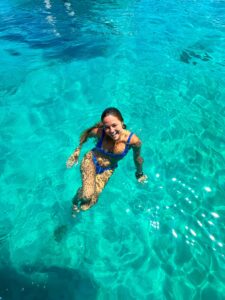
The turquoise colour of the Blue Lagoon is not a filter. It is not enhanced in photos. It genuinely looks like that. The explanation is simple: exceptionally clear water above a white sandy seabed, with direct Mediterranean sunlight hitting it at the perfect angle. The white sand reflects light back up through the water column, creating the vivid turquoise colour that looks almost artificial when you first see it.
The water is clean partly because of the natural currents that pass through the channel between Comino and Cominotto, and partly because Comino has almost no human habitation and consequently almost no sources of pollution close to the lagoon. The protected status of the island as a Natura 2000 site ensures this remains the case.
The Access Pass — How It Works in 2026
Since May 2025, everyone wanting to step ashore at the Blue Lagoon must register for a free access pass — the Blue Lagoon Access Management System (AMS). This was introduced by the Government of Malta to protect Comino’s fragile ecosystem from the overcrowding that previously saw up to 12,000 visitors per day on a bay that can comfortably hold a fraction of that number.
Key facts:
- Completely free — no charge
- Register at: www.blcomino.com
- Three time slots: Morning (08:00–13:00), Afternoon (13:30–17:30), Evening (17:30–22:00)
- Book for up to 4 guests per registration
- QR code sent by email — show it on arrival for a wristband
- No ticket = turned away at the jetty
Private boat guests who swim directly from the boat without going ashore do not need an access pass. This is one of the key practical advantages of a private boat charter — you anchor in open water, swim in the lagoon, and never need a wristband.
For the complete ticket guide, see our Blue Lagoon Malta ticket guide 2026.
Water Temperature — Month by Month
The Blue Lagoon is swimmable year-round, though the experience varies significantly by season.
- January: 17.3°C / 63.1°F
- February: 16.4°C / 61.5°F
- March: 16.4°C / 61.5°F
- April: 17.2°C / 63.0°F
- May: 19.6°C / 67.3°F
- June: 24.5°C / 76.1°F
- July: 26.7°C / 80.1°F
- August: 28.0°C / 82.4°F — warmest month
- September: 27.0°C / 80.6°F
- October: 24.5°C / 76.1°F
- November: 22.2°C / 72.0°F
- December: 18.7°C / 65.7°F
💡 Local Tip: September is the sweet spot. Water is nearly as warm as August (27°C / 80.6°F) but visitor numbers drop significantly after the summer school holidays end. You get peak water warmth with significantly fewer crowds.
Shade, Sun Loungers, and the 10:30am Problem
There are approximately 100 umbrellas and 200 sun loungers available for hire at the Blue Lagoon shore area. In peak summer — July and August — they are completely rented by 10:30am. If you arrive after that expecting shade, you will not find any.
This is not a minor inconvenience. The Maltese summer sun reflects off the limestone and off the water. UV exposure at the Blue Lagoon is significantly higher than on a standard beach. Bring your own hat, high-factor sunscreen, and a UV cover-up if you plan to stay on shore.
On a private boat, there is a shade canopy throughout the tour. Consequently, boat guests never have this problem.
The Pineapple Cocktails
One of the Blue Lagoon’s most recognisable experiences — the cocktails served inside a real hollowed pineapple, sold from vendors on shore and from a boat that moves through the lagoon.
2026 prices:
- With alcohol: €10 (600ml / approximately 1 pint)
- Virgin: €8
- Refill with alcohol: €5
- Refill without alcohol: €4
- Flavours: Mojito, Sex on the Beach, Cosmopolitan, Long Island Iced Tea, Piña Colada, and more
On our private boat tours, your skipper can arrange for the pineapple cocktails to be delivered to the boat at the jetty — so you get the full Blue Lagoon experience without leaving the water.
Food at the Blue Lagoon
Several food kiosks operate on shore. All supplies are transported to Comino daily by small boat from Malta — which explains the slightly elevated prices compared to the mainland.
Approximate 2026 prices:
- Burger: €8
- Wrap: €7.50
- Hot dog: €6
- Snacks and ice cream: from €2
Bring cash — card acceptance is limited on Comino.
Lifeguards — Updated for 2026
From 2026, lifeguards are on duty year-round at the Blue Lagoon, operating 08:00 to 18:00 daily. Previously, lifeguards only worked from May to October. This change significantly improves safety for off-season and winter visitors.
The beach operates a flag system:
- Green: Safe to swim
- Yellow: Safe but be aware of conditions
- Purple: Jellyfish or sea pests present
- Red: Dangerous waves or currents — do not enter
- Double red: Extremely dangerous — do not enter
Currents at the Blue Lagoon
The Blue Lagoon is open at both ends of the channel between Comino and Cominotto. As a result, currents pass through, particularly in the afternoon during summer. The current usually travels south — from Gozo toward Malta — though it occasionally reverses. Summer currents are stronger than winter.
Always stay aware of your position relative to your boat or a safe exit point. If you feel a current, swim at an angle across it rather than directly against it.
The Evening Slot — Comino’s Best Kept Secret
The evening time slot — 17:30 to 22:00 — is the most underused and most underappreciated option at the Blue Lagoon. Most tourists simply do not know it exists.
By 17:30, the day-trippers and ferry crowds have largely gone. The light turns golden at sunset. The lagoon becomes quieter, more atmospheric, and genuinely magical. The turquoise water catches the last of the sun at a low angle that creates colours almost impossible to describe.
If you want the Blue Lagoon without the chaos — book the evening slot. Register free at www.blcomino.com.
💡 Local Tip: For the ultimate Blue Lagoon day — arrive by private boat in the morning for the clearest water and fewest crowds, then book an evening shore slot separately for the golden hour. You get the Blue Lagoon twice in one day, from two completely different angles, in two completely different atmospheres.
Crystal Lagoon — Deeper, More Vivid, and Often Overlooked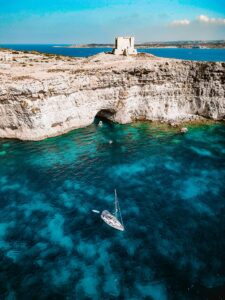
Most visitors to Comino focus entirely on the Blue Lagoon and never discover that the Crystal Lagoon — just minutes away — is in many ways more extraordinary.
Located below Saint Mary’s Tower, the Crystal Lagoon offers deeper water and a more intense colour than the Blue Lagoon. Where the Blue Lagoon is shallow and turquoise, the Crystal Lagoon is deeper and shifts into a richer, more electric blue-green that catches the light differently throughout the day.
The Crystal Lagoon is less crowded than the Blue Lagoon — partly because the ferry doesn’t stop there, and partly because it requires a short additional boat journey. Private boat guests often find the Crystal Lagoon the more memorable of the two.
Snorkelling at the Crystal Lagoon
The snorkelling around the Crystal Lagoon is exceptional. Popeye Cave sits at the eastern edge — the cave named after the 1980 Robin Williams film — and the underwater terrain around its entrance is rich with Mediterranean reef fish.
Sea bream, wrasse, damselfish, painted comber, and occasional grouper are all commonly spotted. The clarity of the water means visibility is consistently excellent — on a calm day, you can see 15 to 20 metres.
Access: The Crystal Lagoon requires no Blue Lagoon access pass. There is no shore restriction system in place. Private boats can anchor freely.
For the complete Crystal Lagoon guide, check out this dedicated guide.
The Comino Caves — The Hidden Wonders Most Visitors Never See
This is where Comino truly becomes extraordinary — and where the difference between a ferry trip and a private boat tour becomes most apparent.
Comino’s coastline is riddled with sea caves. The island’s geology — upper coralline limestone shaped over millions of years by wind and water — has produced dozens of cave formations, some barely large enough to swim into and some vast enough to anchor a boat inside. The most famous are accessible only by private boat. None of them are on the ferry route.
Here is the complete guide to every cave worth knowing about.
1. Lovers Cave — The Most Famous Hidden Beach in the Mediterranean
Lovers Cave is the one cave that genuinely silences people when they first see it.
The cave entrance opens directly from the sea on the north coast of Comino — a dark opening in the cliff face that gives no indication of what lies inside. You enter by boat or by swimming with a life ring, moving through the cave entrance and into the gradually narrowing passage.
Forty metres inside the cliff — in complete darkness except for the light coming from the entrance and the glow of the water below — the cave opens into a hidden chamber. And at the end of that chamber: a 12-metre white sandy beach, illuminated by reflected light from the sea outside, surrounded by limestone walls, and almost entirely silent.
The beach is not visible from any boat anchored outside. It is not visible from the cliff above. It exists inside the rock, known only to people who go all the way in.
The Count of Monte Cristo connection: Lovers Cave was used as a filming location for The Count of Monte Cristo — specifically for the secret passage to the hidden treasure cave that drives the plot of the film. The production designers reportedly chose the cave because its dramatic interior required almost no modification to look like a place where treasure might be hidden for centuries. The cave did that job by simply being what it is.
Practical details:
- Accessible only by private boat or by swimming with a float
- Depth inside: approximately 8–10 metres at the entrance, shallower toward the beach
- Always bring a life ring or visible float if swimming in — other boats need to see you
- Total depth of cave: approximately 40 metres from entrance to beach
💡 Local Tip: Swim into Lovers Cave slowly and let your eyes adjust to the darkness before you reach the beach. The moment the hidden sandy beach comes into view as your eyes adjust is one of the most remarkable natural experiences available anywhere in the Maltese islands. Bring a waterproof torch to see the full interior.
2. Popeye Cave — Named After Robin Williams
Popeye Cave sits east of the Crystal Lagoon and takes its name from the 1980 Robin Williams film Popeye, in which a scene featuring a giant octopus was filmed here.
The cave is architecturally quite different from Lovers Cave. It features a massive open cavity with a collapsed ceiling — a natural skylight that allows sunlight to pour directly into the cave interior and reflect off the enormous limestone boulders below. The result is extraordinary: deep inside what appears from the sea to be a dark cave, the light from above creates dramatic, shifting patterns on the water and walls.
There is also a hidden detail inside Popeye Cave that most visitors miss. A rock formation inside the cave — difficult to see until someone points it out — is known locally as the guardian of the cave. Ask your skipper to show you. Once you see it, you cannot unsee it.
The cave also goes by several local Maltese names: L-Għar ta’ Bla Saqaf (the cave without a ceiling), Ħat il-Ħneja, and L-Għar il-Bejta tal-Fenek.
3. Alex Cave — The Air Pocket and the Damselfish
Alex Cave is smaller and more intimate than Lovers Cave or Popeye Cave — but it has something neither of the others have: a natural air pocket inside the cave where the water level drops to reveal a space between the water surface and the cave ceiling that traps air.
Inside Alex Cave, you can surface inside the rock — literally inside the cliff, with the cave ceiling a few inches above your head and the Mediterranean outside. It is a genuinely extraordinary sensation.
Additionally, Alex Cave is home to a resident population of damselfish — bold, small, and intensely territorial. They will come remarkably close to swimmers and snorkellers, which makes the cave one of the best locations around Comino for underwater photography. The combination of the air pocket, the fish, and the dramatic cave interior makes Alex Cave a memorable stop for every age group.
Alex Cave also provides an excellent natural frame for drone photography — the DJI Inspire was reportedly used for shots at this location, and the circular opening of the cave with the turquoise water beyond creates one of the most striking aerial compositions available around Comino.
4. Santa Marija Caves — Paradise for Divers and Free Divers

Santa Marija Cave
The Santa Marija cave complex on Comino’s northern coast is different in character from the other caves — broader, more accessible, and home to some of the best diving and free diving on the island.
The complex consists of five main caves, each with distinct characteristics. The first three are the most popular for snorkelling, with accessible entrances and vivid aquatic life. The fourth cave features striking blue waters and rich coral formations that make it particularly rewarding for underwater photography. The fifth cave presents a more adventurous challenge — deeper, darker recesses that lead to a secluded air pocket, best explored with a waterproof torch.
For divers: The Santa Marija caves feature extensive underwater tunnel systems that connect the cave interiors. Multiple air pockets throughout the complex make this an extraordinary night diving location — the tunnels lit by torch, the air pockets creating strange, cathedral-like spaces beneath the rock. Advanced divers consistently rate the Santa Marija caves among the best diving experiences in Malta.
For free divers: The cave walls provide excellent hand holds and the relatively moderate depths make free diving here accessible to intermediate level athletes. Deep water solo climbing has also been practised on the cave walls — the Santa Marija cave complex attracts a genuine climbing community during the quieter months.
5. Crystal Lagoon Tunnel Cave
Located on the western side of Comino at the edge of the Crystal Lagoon, this cave is unusual in that it passes completely through the island — entering on one side and exiting on the other, creating a navigable tunnel through the rock.
The tunnel is narrow — not large enough for a full-sized boat — but accessible by kayak or swimming. It connects the Crystal Lagoon side of Comino to the open water on the island’s southern coast. Beyond the exit, numerous smaller sea caves continue along the cliff face, each with its own character and each worth investigating.
The tunnel cave has become popular with cliff divers, rock climbers, and snorkellers who want to experience Comino from an angle most visitors never access.
6. The Cominotto Cave — Private Lagoon and Hidden Beach
On Cominotto — the tiny island directly opposite the Blue Lagoon — there is a sea cave that contains its own private world: a small lagoon inside the cave, and at the end of that lagoon, a small sandy beach.
Like Lovers Cave on Comino, the Cominotto cave beach is invisible from outside. You enter from the sea, pass through the cave opening, and find yourself in a completely enclosed space — turquoise water above white sand, limestone walls on all sides, and a small beach at the far end. No ferry goes here. No day tripper finds it without a private boat.
The Troy connection: The Cominotto cave was reportedly used as a filming location for the Brad Pitt film Troy — the cave’s passage from one side of the islet to the other providing a dramatic natural set. The combination of film locations on Comino (The Count of Monte Cristo at Lovers Cave) and on Cominotto (Troy) adds another layer to the extraordinary natural character of this small archipelago.
For the complete guide to Cominotto, check out this guide to Malta’s best kept secret.
Cominotto — The Blue Lagoon’s Quieter, More Beautiful Neighbour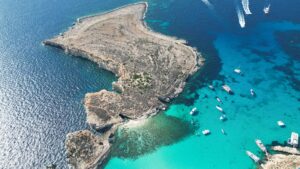
Cominotto is the island that most Blue Lagoon visitors can see — it’s the low rocky mass directly across the channel — but almost nobody visits.
The island is uninhabited, has no facilities, and is accessible only by private boat. There is no ferry service to Cominotto. No day cruise stops there. The Blue Lagoon access pass system applies only to Comino’s shore — no access pass is required to visit Cominotto.
What Cominotto offers, consequently, is the Blue Lagoon experience without the crowds. The water around Cominotto is just as vivid as the Blue Lagoon itself — the same white sandy seabed, the same turquoise colour, the same Mediterranean clarity. The snorkelling over the Cominotto reef is arguably the best snorkelling in the entire lagoon area.
On our private boat tours, Cominotto is consistently one of the most memorable stops — guests who have been to the Blue Lagoon before often find Cominotto the more remarkable experience.
Santa Marija Bay — The Best Beach on Comino
Most Comino visitors never make it to Santa Marija Bay. It requires a 25-minute walk from the Blue Lagoon or a short additional boat journey — and most people on a day trip simply don’t have the time or the inclination.
This is their loss. Santa Marija Bay is the largest and arguably the best beach on Comino — and it is consistently less crowded than the Blue Lagoon.
Why Santa Marija Bay Is Different
The key difference between Santa Marija Bay and the Blue Lagoon is shade. Santa Marija Bay is fringed by natural tamarisk trees that provide genuine, consistent shade along the beach edge — something the Blue Lagoon completely lacks after 10:30am.
The water at Santa Marija Bay is shallow and calm — ideal for families with young children, non-swimmers, and anyone who wants a relaxed beach day rather than an intense swim stop. The sandy bottom is white and clearly visible, making the water appear that distinctive Caribbean turquoise that photographers seek.
The Santa Marija Chapel

santa marija chapple comino
On the beach at Santa Marija Bay stands a small medieval chapel — with roots stretching back to the 13th century. Mass is still celebrated there every Sunday, making it one of the most remote and atmospheric churches in the Maltese islands. The combination of the ancient chapel, the beach, the tamarisk trees, and the view across the water creates an atmosphere quite unlike anything else available on Comino.
The Campsite
Santa Marija Bay is also home to Comino’s only legal campsite — a designated camping area close to the bungalows of the former Comino Hotel. The campsite has basic toilet facilities. Camping outside the designated area is prohibited.
For those who want the experience of Comino after the day-trippers have gone — when the island becomes genuinely quiet and atmospheric — camping at Santa Marija Bay is one of the most memorable ways to do it.
Facilities at Santa Marija Bay
- Public showers (under banana trees)
- Public toilets
- The Santa Marija Chapel
- The campsite
- A small restaurant/snack bar associated with the former hotel complex
For the complete guide, check out this Santa Marija Bay guide.
San Niklaw Bay — The Quietest Corner of Comino
San Niklaw Bay sits on the northern coast of Comino — a charming, sheltered cove with a sandy beach, calm water, and natural surroundings. It is the location of the former Comino Hotel and is consequently further from the main visitor routes than either the Blue Lagoon or Santa Marija Bay.
The bay is used by private boat guests who want an anchor point away from any crowds. The water is calm, the entry is easy, and the surroundings — rocky cliffs, sparse vegetation, and the open sea beyond — give it a character quite different from the lagoon beaches.
San Niklaw Bay is also the departure point for the hotel’s former shuttle service to Malta and Gozo — a connection that physically linked this remote bay to the broader world. When the Six Senses hotel opens, this bay will likely become the main arrival point for its guests.
Saint Mary’s Tower — Comino’s Medieval Watchtower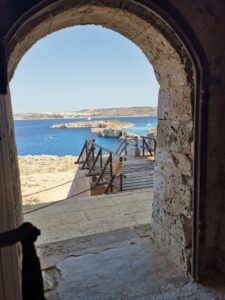
Saint Mary’s Tower stands on the headland above the Blue Lagoon — built between 1618 and 1620 under Grand Master Alof de Wignacourt as part of Malta’s coastal defence network.
The tower is circular, approximately 9 metres in diameter and 14 metres tall, and is constructed of the same golden limestone that forms the island. It was designed to provide warning of approaching vessels — the watchmen inside could communicate with towers on Malta and Gozo using a system of fire signals that allowed information to travel across the islands almost instantaneously.
The tower survived everything that was thrown at it over four centuries — Ottoman raids, Barbary corsair attacks, British colonial rule, and the tourist revolution that transformed the lagoon below it. Today it stands exactly as it was built, one of the best-preserved coastal watch towers in the Maltese islands.
When to visit: Look for the Knights’ flag flying from the tower — it signals that the tower is open for visitors. The walk from the Blue Lagoon takes approximately 15 minutes. Admission is free. The views from the tower roof across the lagoon and out to sea are extraordinary.
For the complete guide, check out this dedicated guide to Saint Mary’s Tower.
Comino’s Wildlife — What Lives Here
Comino is a Natura 2000 protected site, and the biodiversity of the island reflects that protection.
The Vegetation
The island’s flora includes several endemic Maltese species found almost nowhere else in the world:
- Maltese Fleabane
- Maltese Sea Lavender
- Maltese Salt Tree
- Maltese Tree Spurge
- Mediterranean Thyme
- Silvery Ragwort
- Bushy Rest Harrow
The vegetation is most vivid in spring — when green plants carpet the rocky hillsides after the winter rains, creating a striking contrast with the turquoise water below. By summer, the vegetation has dried and the island takes on its characteristic golden-brown colour.
Marine Life at the Blue Lagoon
The protected status of the Comino marine area means the underwater ecosystem is rich and well-established. Species commonly seen snorkelling around Comino include:
- Sea Bream (Awrata) — in shoals throughout the lagoon
- Parrotfish (Marzpan) — vivid colours, one of the most striking fish in the lagoon
- Wrasse (Merli) — curious and bold, often approaches snorkellers
- Damselfish — in large numbers around rocky sections
- Painted Comber (Sirrana) — distinctive striped markings
- Grey Mullet (Mulett) — in loose groups near the lagoon edges
- Grouper (Cerna) — in deeper sections, shy but impressive
- Moray Eel — in rocky crevices and cave entrances
- Octopus — common in rocky areas, particularly away from the main shore
- Starfish — common on the sandy bottom
Dolphins
Dolphins do not typically appear inside the Blue Lagoon itself, but they are spotted regularly in the channel between Malta and Comino — particularly on the journey from Cirkewwa in the early morning. On our private boat tours, we spot dolphins roughly once or twice a week, usually before 09:00.
Sea Urchins
Sea urchins are found near rocks around the bay edges. Do not touch or step on them. Their spines break inside the skin and must be removed carefully — by a lifeguard, at a hospital, or with a sterilised needle for minor cases. Water shoes are the best prevention.
Jellyfish
Jellyfish occasionally appear at Comino — typically in spring rather than peak summer. Whether they’re present on any given day depends on wind direction and currents. The purple flag at the Blue Lagoon indicates their presence.
Things to Do on Comino Beyond the Blue Lagoon
Swimming and Snorkelling

free dive crystal waters
The entire coastline of Comino is available for swimming and snorkelling. The Blue Lagoon and Crystal Lagoon are the most famous spots, but Santa Marija Bay, San Niklaw Bay, and the rocky sections around the cave entrances all offer excellent marine life and visibility.
The best snorkelling away from the main beach area is consistently found around the cave entrances — where the rocky structure provides habitat for a diverse range of species.
Kayaking
Sit-on-top kayaks are available for hire at the Blue Lagoon during the summer months (June to August). Comino’s coastline has approximately 30 sea caves — many accessible only by kayak or swimming — making it one of the most rewarding kayaking environments in the Mediterranean.
From the Blue Lagoon by kayak, you can reach the Crystal Lagoon, the Crystal Lagoon Tunnel Cave, and several smaller caves along the north coast of the island. The kayak gives you access to spaces that even small boats cannot reach.
Diving and Free Diving
Comino is listed among the top 10 dive sites in Malta. The Santa Marija Caves are the main draw — extensive underwater tunnel systems, multiple air pockets, and rich marine life. The P31 WWII wreck (a German minesweeper scuttled as an artificial reef — 10 metres to the top, 18 metres to the seabed) is also accessible from Comino waters.
Free diving around Comino’s cave entrances is a popular activity for intermediate and advanced free divers. The Santa Marija cave walls offer deep water solo climbing routes as well.
Hiking Comino
Comino is small enough to walk around in a few hours. The island’s paths connect the Blue Lagoon to Saint Mary’s Tower (15 minutes), the tower to Santa Marija Bay (20 minutes), and Santa Marija Bay back toward the lagoon. A complete circuit of the island on foot takes approximately 2 to 3 hours at a comfortable pace.
The eastern cliffs of Comino — the tallest and most dramatic section of the coastline — are best approached from the tower area. The views from the cliff tops across to Gozo and south toward Malta are extraordinary.
Cliff Diving
Several sections of Comino’s coastline offer cliff diving opportunities — and the variety of heights and entry points means there is something for every level of confidence, from first-timers to experienced cliff divers.
🥇 Crystal Lagoon — The Best Cliff Diving on Comino
The Crystal Lagoon is the top choice for cliff diving — and by some margin. The surrounding limestone offers the greatest variety of jump heights available anywhere around Comino, from low ledges of 1 to 2 metres that are ideal for beginners and children, up to serious heights for experienced divers. The water is deep, clear, and consistently calm — the ideal combination for cliff diving. Furthermore, the dramatic setting of the Crystal Lagoon itself — deep blue water surrounded by limestone cliffs — makes it one of the most visually striking places to jump anywhere in Malta.
🥈 Cominotto — Dramatic and Private
The cliffs and rock formations around Cominotto offer excellent cliff diving in a setting that feels genuinely remote. Accessible only by private boat, Cominotto consequently never gets the crowds that can make cliff diving at more accessible locations feel rushed or competitive. The entry points are dramatic and the water around the island is deep and clear.
🥉 Santa Marija Caves — For the More Adventurous
The cave area at Santa Marija offers cliff diving opportunities that are more technical and more rewarding for experienced divers. The combination of cave walls, rock formations, and deep water creates entry points that require more judgment and experience than the Crystal Lagoon options. Additionally, the marine life visible in the clear water below makes the moment before the jump genuinely extraordinary.
💡 Local Tip: Always check the depth personally before jumping from any spot — even spots you have seen others jump from. Water levels and underwater rock formations vary. Never jump from an unfamiliar spot without local knowledge, and always have someone watching from the boat. Your skipper will know which spots are safe and which heights are appropriate for your group. 🚤
Photography
Comino is one of the most photogenic places in Europe. The combination of the turquoise water, the golden limestone, the ancient tower, the hidden caves, and the wild coastline creates an almost unlimited range of photographic subjects.
Best spots:
- Bow of the private boat at the Blue Lagoon — the water colour from the bow platform is extraordinary
- Crystal Lagoon from the water — the colour intensity is remarkable
- Lovers Cave beach — a photo that genuinely looks impossible
- Saint Mary’s Tower at dawn — the tower against the morning sky
- Cominotto from the Blue Lagoon side — the tiny island with turquoise water in the foreground
Best times:
- Above water and drone: morning (09:00–11:00) and late afternoon
- Underwater: midday (11:00–14:00) when sun penetrates deepest
- Shore photography: before 09:00 before the crowds arrive
How to Get to Comino
🚤 Private Boat Charter — The Best Option

comino boat trips, group of friends malta
A private boat from Cirkewwa reaches Comino in approximately 10–15 minutes. Unlike the ferry, the private boat anchors in open water away from the shore, gives you access to the sea caves, takes you to Cominotto, and allows you to swim directly from the boat without needing the Blue Lagoon access pass.
Departs from: Cirkewwa (north Malta) or Mġarr Harbour (Gozo)
Private boat options:
- 2-Hour Private Boat Tour — Blue Lagoon and Crystal Lagoon
- 3-Hour Private Boat Tour — Full Comino circuit including sea caves ⭐ Most popular
- 6-Hour Private Boat Tour — Comino plus Gozo coastline
- Self-Drive Rental — No licence needed, explore at your own pace
👉 Book a private boat tour here.
🚢 The Comino Ferry — Budget Option
Ferries depart from Cirkewwa (north Malta) and Mġarr Harbour (Gozo). The crossing from Cirkewwa takes approximately 20–25 minutes. In summer, ferries run approximately every hour from 10:00 to 17:00.
Departs from: Cirkewwa (Malta) or Mġarr Harbour (Gozo) Price: €15 adult return, €7 for children under 9. Most ferry operators include the Blue Lagoon access pass with your ticket — confirm before buying.
The ferry is the cheapest way to reach Comino and perfectly adequate for a budget visit. However, you arrive at the same time as everyone else on the same ferry, on the same crowded beach. Go on the first departure of the day for the best experience.
🛳️ Group Boat Tour — The Social Option
Group boat tours operate on fixed daily itineraries covering Comino, the Blue Lagoon, Crystal Lagoon, and usually a section of the Gozo or Malta coastline. You share the boat with other passengers — typically 20 to 50 people — and follow a fixed schedule with set departure and return times.
Departs from: Sliema and Buġibba — the two main departure points for group tours in Malta
What to expect:
- Departure from Sliema or Buġibba approximately 10:00
- Arrival at the Blue Lagoon approximately 12:00 — midday, at peak crowds
- Return approximately 17:00
- Approximately 3 to 3.5 hours of the day spent sailing, with 1 to 1.5 hours at the Blue Lagoon itself
Group tours are a reasonable option for solo travellers who enjoy a social atmosphere, or for those on a budget without a group to split a private charter with. The trade-off is a fixed schedule, a shared boat, and a midday arrival at the Blue Lagoon when it is at peak capacity.
💡 Local Tip: If you book a group tour, check whether the itinerary visits Gozo first or Comino first. Tours that go to Gozo first tend to arrive at the Blue Lagoon in the early afternoon as the midday crowds start to thin — often a noticeably better experience than arriving at noon alongside every other group tour on the water.
🏍️ Jet Ski Safari — For the Adventurous
The 2-hour jet ski safari from Cirkewwa covers the full Comino circuit at speed — Blue Lagoon, Crystal Lagoon, sea caves, and the surrounding coastline. No licence required. No experience necessary.
Departs from: Cirkewwa (north Malta)
🚣 Kayak — From Gozo Only
Kayaking to Comino is feasible for experienced paddlers — but only from Gozo. The crossing from Malta’s Cirkewwa is too far and too exposed for casual kayakers. From Gozo, the distance is shorter and more manageable on a calm morning, though open water experience and awareness of currents is still essential.
Departs from: Gozo only
Sit-on-top kayaks are also available for hire at the Blue Lagoon itself during June, July, and August — a great option for exploring the lagoon and nearby cave entrances once you have arrived by another method.
The Honest Ranking — Best to Worst
| Option | Departs From | Best For |
|---|---|---|
| 🥇 Private boat | Cirkewwa or Mġarr Gozo | Everyone — sea caves, flexibility, best water |
| 🥈 Jet ski safari | Cirkewwa | Adventure seekers, speed, full Comino circuit |
| 🥉 Self-drive rental | Cirkewwa | Experienced boaters wanting total freedom |
| 4. Comino ferry | Cirkewwa or Mġarr Gozo | Budget visitors — first morning departure is best |
| 5. Group tour | Sliema or Buġibba | Solo travellers, social atmosphere, fixed budget |
| 6. Kayak | Gozo only | Experienced paddlers only |
For the complete comparison of all ways to reach the Blue Lagoon, check out this guide — 6 ways to get to the Blue Lagoon Malta ranked. 🚤
When to Visit Comino
Peak Season — July and August
The busiest months. Water temperature peaks at 28°C / 82.4°F. However, the Blue Lagoon receives up to 4,000 visitors per day on shore, the sun loungers are gone by 10:30am, and the ferry queues are long. If you visit in July or August, the private boat option is genuinely essential for any kind of quality experience.
Shoulder Season — May, June, September, October ⭐ Recommended
The sweet spot. Water is warm (20–27°C / 68–81°F), the weather is excellent, and visitor numbers are a fraction of peak season. September is particularly outstanding — water still at 27°C but the summer crowds have gone. October offers warm sea, golden light, and an almost entirely uncrowded lagoon.
Off Season — November to April
Quiet, atmospheric, and genuinely beautiful. The Blue Lagoon in winter is an extraordinary experience — wild, silent, and yours. Water is cold (16–19°C / 61–67°F) but the clarity of the air and the quality of the light make it one of the most photogenic times to visit.
Practical Information — Before You Go
What to Bring
- High-factor sun cream (SPF 50+) — essential
- Water shoes — for rocky entries and cave swimming
- Snorkelling mask and fins — provided free on private boat tours
- Cash — limited card acceptance on Comino
- Water — stay hydrated in the Maltese sun
- A dry bag — for phones and valuables on the water
Safety at the Blue Lagoon
- Always check the flag system before swimming
- Be aware of currents, particularly in the afternoon
- Never jump from cliff spots you haven’t personally verified for depth
- Stay visible when swimming away from shore — carry a surface marker buoy for snorkelling
Getting the Most From the Sea Caves
- Only accessible by private boat or swimming
- Always swim into caves with a life ring or visible float
- Bring a waterproof torch for deeper exploration
- Tell your skipper which caves you want to visit — they will know the best approach and conditions
The Six Senses Hotel — What Is Coming to Comino
Comino Hotel
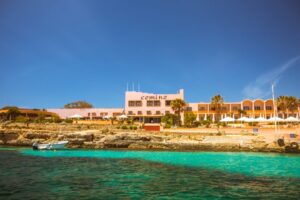
This is the development no other Comino guide has covered. Planning permits were approved in 2026 and construction is scheduled to begin in May 2026. The former Comino Hotel at San Niklaw Bay is being converted into a Six Senses resort — one of the world’s leading luxury hotel brands, operating properties in locations including the Maldives, Bhutan, and Ibiza.
When complete, the Six Senses Comino will transform the accommodation offer of the island entirely. For the first time in years, it will be possible to stay overnight on Comino in genuine comfort — with the full Six Senses wellness and sustainability philosophy applied to one of the most extraordinary natural settings in the Mediterranean.
The arrival of Six Senses will inevitably change the character of Comino somewhat — but the protected status of the island as a Natura 2000 site means development will remain strictly limited to the hotel’s footprint. The coastline, the caves, the lagoons, and the wild character of the island will remain unchanged.
Book Your Comino Private Boat Tour
The best way to experience Comino is from the water, on a private boat, with a local skipper who knows every cave, every anchorage, and every secret spot on the island.
Every tour we run includes snorkelling gear, life jackets, pool noodles, floaties, shade canopy, cool box with ice, toilet on board, and all fuel and permits. Your skipper handles everything — you just enjoy it.
👉 Book a private Comino boat tour with Outdoor Explorers Malta here.
We depart from both Cirkewwa (Malta) and Mġarr Harbour (Gozo). Questions? Contact us here.
Frequently Asked Questions — Comino Island Malta
What is Comino Island Malta?
Comino is the third island of the Maltese archipelago — a 2.8 square kilometre island between Malta and Gozo, famous for the Blue Lagoon, its sea caves, and its virtually uninhabited wild landscape. It is a protected Natura 2000 site.
How do you get to Comino?
By sea only — there are no roads connecting Comino to Malta or Gozo. Options include the Comino ferry from Cirkewwa or Mġarr Harbour, a private boat charter, or a jet ski safari. Private boat is the best option for accessing the sea caves and Cominotto.
Does anyone live on Comino?
A tiny number of people — fewer than five — live permanently on Comino. The most well-known resident is Salvu, who grows his own vegetables and lives a self-sufficient life on the island. The Comino Hotel closed in recent years and is being converted into a Six Senses resort.
Is the Blue Lagoon worth visiting?
Yes — but how you visit determines everything. On a private boat anchored in open water it is one of the most beautiful swimming experiences in the Mediterranean. On a crowded midday ferry in July it is significantly less rewarding. Plan it right and it absolutely delivers.
Do you need a ticket for the Blue Lagoon?
Yes — a free access pass is required to step ashore. Register at www.blcomino.com before you travel. Private boat guests who swim from the boat without going ashore do not need a pass.
What are the best caves on Comino?
Lovers Cave (hidden sandy beach 40 metres inside the cliff), Popeye Cave (collapsed ceiling with natural skylight), Alex Cave (air pocket and resident damselfish), Santa Marija Caves (best for diving), Crystal Lagoon Tunnel Cave, and the Cominotto Cave (private lagoon and hidden beach). All require a private boat to access.
What is Cominotto?
Cominotto is the tiny uninhabited island directly across from the Blue Lagoon — approximately 0.25 square kilometres, accessible only by private boat. The water around Cominotto is just as vivid as the Blue Lagoon and the snorkelling is arguably better. No access pass required.
How far is Comino from Malta?
Comino is approximately 3.5 kilometres from Cirkewwa in northern Malta. By private boat from Cirkewwa the crossing takes 10–15 minutes. By ferry it takes approximately 20–25 minutes.
What is the best time to visit Comino?
September is the sweet spot — water at 27°C, significantly fewer crowds than July and August. May and June are also excellent. For a genuinely crowd-free experience, the evening time slot (17:30–22:00) at the Blue Lagoon is the best kept secret on the island.
What is the Six Senses hotel on Comino?
The former Comino Hotel at San Niklaw Bay is being converted into a Six Senses resort. Planning permits were approved and construction is scheduled to begin in May 2026. It will be the first luxury hotel to open on Comino in years.
What marine life can you see at Comino?
Sea bream, parrotfish, wrasse, damselfish, painted comber, grouper, moray eels, octopus, and starfish are all commonly seen. Dolphins are spotted regularly in the Malta-Comino channel, typically before 09:00. Jellyfish appear occasionally in spring.
Can you snorkel at Comino?
Yes — extensively. The Blue Lagoon, Crystal Lagoon, Santa Marija Bay, and all the sea cave entrances offer excellent snorkelling. Snorkelling gear is included free on all our private boat tours.
What is the P31 wreck?
The P31 is a German WWII minesweeper scuttled in the waters near Comino as an artificial reef. It sits at 18 metres to the seabed with the top at approximately 10 metres — accessible to recreational divers. One of the most accessible wreck dives in the Maltese islands.