

St Peter’s Pool Malta — The Complete Local Guide 2026
There is no sand. No sun loungers. No beach bar serving overpriced cocktails.
What St Peter’s Pool offers instead is something far rarer — a horseshoe-shaped natural pool carved into Malta’s southern limestone coast by centuries of Mediterranean waves, with water so clear you can see the bottom from 8 metres up before you even jump in.
It is raw, dramatic, completely undeveloped, and genuinely one of the most beautiful natural swimming spots in the whole of the Maltese islands. Locals have known about it for years. Social media has since told the rest of the world. And still, somehow, it has managed to keep most of its magic intact.
This guide gives you everything — the history, how to get there, what to bring, cliff diving, snorkelling, private boat tours from Marsaxlokk, and the insider knowledge that no other St Peter’s Pool guide has.
St Peter’s Pool Malta — Quick Facts 2026
| Official Name | Peter’s Pool (Maltese: Il-Bajja ta’ Pietru) |
| Location | Delimara Point, near Marsaxlokk, southeast Malta |
| Type | Natural limestone rock pool — no sand |
| Water | Crystal clear, deep, excellent visibility |
| Cliff jumping | Yes — multiple heights, 3 to 7.5 metres |
| Snorkelling | Excellent — clear water, rich reef, small cave at western end |
| Facilities | None — bring everything you need |
| Lifeguards | None — swim at your own risk |
| Parking | Free at cliff top (10-min walk) or €3 closer to the pool |
| Best time | Before 10:00 in summer — crowds arrive fast |
| Getting there | Car, bus + walk, water taxi from Marsaxlokk, private boat |
| Boat tours | Private boat tours from Marsaxlokk available from 2026 |
| Famous residents | Titti the diving dog (1st viral sensation, died 2019) — Tina carries on the tradition |
| Nearby village | Marsaxlokk — 15 to 20 minutes by car |
<h2>
What Makes St Peter’s Pool Special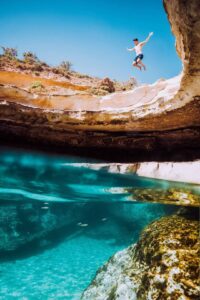
A Natural Masterpiece Thousands of Years in the Making
St Peter’s Pool did not happen overnight. Thousands of years of Mediterranean waves crashing against Malta’s southern limestone coast carved this extraordinary horseshoe-shaped formation into the rock — shaping natural steps leading down to the water, smooth ledges for sunbathing, and a sheltered pool whose walls create a natural windbreak that keeps the water surprisingly calm even on breezy days.
The pool itself has a brilliant gradient. Shallow enough near the edges for nervous swimmers to wade in carefully, and deep enough in the centre for cliff jumping that will get your heart rate up regardless of how many times you have done it before. The limestone walls are smooth from centuries of erosion — warm underfoot in the afternoon sun, cool in the early morning shade.
What makes the water so clear is also the limestone. The rock acts as a natural filter — there is no sand to stir up, no river sediment, no development close enough to pollute the bay. The result is visibility that genuinely has to be seen to be believed. On a calm day you can see straight to the bottom from the cliff top before you have even taken your shoes off.
No Development — And That Is the Point
Here is what separates St Peter’s Pool from almost every other swimming spot in Malta: nobody has built anything here. No resort. No beach club. No vendor trying to sell you an overpriced ice cream. Just you, the limestone, the Mediterranean, and that water.
This is increasingly rare. Malta’s coastline has seen significant development in recent decades. Consequently, places that remain genuinely wild and undeveloped have become more valuable — not just aesthetically but experientially. St Peter’s Pool feels like a place that belongs to the sea rather than to the tourist industry, and that feeling is precisely what people come for.
The Fence — What Changed in the Last Two Years
If you have seen recent photographs of St Peter’s Pool and noticed fencing along the cliff edges, this is a 2022–2023 development worth knowing about.
The limestone cliffs surrounding the pool have been eroding over time — a natural geological process accelerated by the constant exposure to wind and sea. Over the past two years, fencing and warning signs have been erected around the clifftop perimeter specifically to prevent falling debris from reaching the pool area below.
The fence is a safety measure, not a restriction on access. The pool itself, the natural steps down to the water, the cliff jumping spots, and the rock platforms for sunbathing are all still fully accessible. However, it does alter the visual character of the clifftop slightly — particularly for photography from above. Go early in the morning if you want the cleaner clifftop composition shots before the light gets harsh.
The History of St Peter’s Pool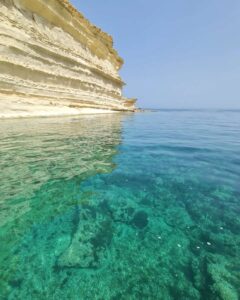
Delimara Point — Centuries of Strategic Importance
St Peter’s Pool sits on the Delimara Peninsula — a finger of land that extends southeast from Malta into the open Mediterranean. This position gave it strategic military significance for centuries. The surrounding headlands were used and fortified by successive powers that controlled Malta.
Several historic landmarks sit within walking distance of the pool, most of which the vast majority of visitors never discover:
- Saint Lucian Tower — built between 1610 and 1611 by the Knights of St John. Now operated as the Malta Aquaculture Research Centre
- Delimara Fort — a British colonial structure built between 1876 and 1878, one of several coastal fortifications built to defend Malta’s southern approaches
- Delimara Lighthouse — built in 1854, today managed by Din l-Art Ħelwa, Malta’s national heritage trust
- Tas-Silġ Archaeological Complex — an extraordinary multi-period site spanning 4,000 years of history from 3000 BC to 900 AD, covering Neolithic, Bronze Age, Phoenician, Punic, Greek, Roman, Byzantine, and Arab occupation. One of the most significant archaeological sites in the Maltese islands
- Tas-Silġ Church — known as the Church of Our Lady of the Snows, built in 1650
- Il-Ħofra il-Kbira and Il-Ħofra iż-Żgħira — two natural lagoons close to St Peter’s Pool, reachable by boat and extraordinary for swimming and snorkelling in near-total privacy
The Diving Dogs — Titti and Tina
No guide to St Peter’s Pool is complete without the story of Titti — the dog who became an international internet sensation by jumping into the pool alongside her owner Carmelo Abela.
The video went viral globally. People flew to Malta specifically to visit St Peter’s Pool in the hope of seeing Titti make her jump. The story captured something genuinely charming — a dog living her best life on a Maltese clifftop, jumping into turquoise water in a place most people in the world had never heard of.
Titti died in 2019. Her legacy, however, lives on. Tina — her successor — can still occasionally be spotted at St Peter’s Pool, demonstrating her own impressive jumping ability to the delight of anyone fortunate enough to be there on the right day. Keep your eyes open. You might just witness the most famous four-legged local continuing a tradition that made this pool famous.
Dom Mintoff’s House — On the Road to St Peter’s Pool
Here is the detail that no other guide mentions.
On the road leading to St Peter’s Pool, you will pass a house called Għar ix — the former home of Dom Mintoff, one of Malta’s most significant and controversial political figures. Mintoff served as Prime Minister of Malta twice — from 1955 to 1958 and again from 1971 to 1984. He was the architect of Maltese independence from Britain in 1964 and one of the defining personalities of 20th-century Maltese politics.
Mintoff kept a dog named Għajn at this house. The house itself — set on the southern coast road with views toward the sea — is modest relative to the outsized historical figure who lived there. It is not signposted and is easy to miss entirely if you do not know to look for it.
💡 Local Tip: As you drive the narrow road toward St Peter’s Pool from Marsaxlokk, look for the house called Għar ix on your left side before you reach the cliff top parking. It is a rare and genuinely local piece of political history in an otherwise touristic landscape. Most visitors drive straight past without any idea of its significance.
How to Get to St Peter’s Pool Malta
By Car — The Best Option
From Marsaxlokk, the drive takes approximately 15 to 20 minutes along increasingly narrow roads that eventually give way to the rocky track leading to the clifftop. Fair warning — these roads are not rental-car-friendly in the conventional sense. They are narrow, occasionally rough, and the final stretch near the pool will require careful maneuvering if you meet oncoming traffic.
From Valletta, the total drive is approximately 40 minutes.
Parking: There is free parking at the top of the cliff, approximately a 10-minute walk from the pool. Closer parking is available for €3 for the day — worth it in summer when the walk back uphill in the heat is less fun than the walk down.
💡 Local Tip: Arrive by 09:00 in July and August. The pool is quiet before 10:00 and overcrowded by noon. By the time we left at 1pm one Sunday, there were well over 100 people and queues of cars on the only road in. The early bird advantage at St Peter’s Pool is significant.
By Bus and Walk
Take bus route 81 or 85 from Valletta to the Abdosir stop. From Marsaxlokk direction, the 119 bus is an alternative. From the bus stop, the walk to St Peter’s Pool takes approximately 30 to 40 minutes along a mostly flat coastal path. The walk itself is pleasant and the views are good. However, the return walk uphill in full Maltese summer heat is genuinely challenging. Bring significantly more water than you think you need.
From Sliema, Buġibba, or St Julian’s, travel to Valletta or Floriana first and then take the 81 or 85 bus.
By Water Taxi from Marsaxlokk
Along the Marsaxlokk waterfront — opposite Roots Restaurant and Sphinx Pastizzeria — you will find a small stall selling tickets for the local water taxis. Tickets cost approximately €10 per person return. You choose a departure time and a collection time, giving you control over how long you spend at the pool.
The water taxi journey takes approximately 20 minutes and is genuinely worth it for the experience alone. You pass fishing boats, the large gas tanker anchored offshore (delivering liquified natural gas to the onshore regasification plant — substantially bigger than it looks), and a stretch of jagged limestone coastline that gives you a preview of what the pool itself will look like from the water.
By Private Boat from Marsaxlokk — From 2026 ⭐
From 2026, organised private boat tours will depart from Marsaxlokk directly to St Peter’s Pool and the surrounding lagoons. This is a significant development for anyone who wants to experience St Peter’s Pool properly — arriving by private boat rather than the crowded clifftop approach gives you a completely different experience.
What the private boat option offers:
- Arrival at the pool from the sea — the horseshoe bay looks extraordinary from the water at sea level
- Swimming directly from the boat in open water, away from the clifftop crowds
- Access to Il-Ħofra il-Kbira and Il-Ħofra iż-Żgħira — the two natural lagoons nearby that are almost impossible to reach from land and that almost nobody visits
- Snorkelling the coastline around Delimara Point, including the small cave at the western end of the bay
- The ability to time your visit to the pool itself for when the clifftop crowd is at its minimum
Contact us here to enquire about private boat tours from Marsaxlokk to St Peter’s Pool from 2026. Alternatively, book a private boat tour here.
Cliff Diving at St Peter’s Pool — The Full Guide
St Peter’s Pool is one of the finest cliff diving spots in Malta — and among the best in the entire Mediterranean for the combination of height variety, water depth, and natural setting.
The Heights
The pool offers multiple jumping points at different heights, which is what makes it genuinely accessible to a wide range of people:
- 1 to 2 metres — gentle entry points at the water’s edge, suitable for first timers and those who want to get in the water without jumping
- 3 to 4 metres — the most popular intermediate height. Thrilling without being terrifying. Where most first-time jumpers start
- 5 to 6 metres — the main cliff jumping spot used by regulars. Most social media footage comes from this height
- 7 to 7.5 metres — the highest point. For experienced cliff jumpers only. The backflips you see in photographs happen here
The Unspoken System
One of the genuinely impressive things about St Peter’s Pool is the informal crowd management system that operates entirely without signs or officials. When the pool is busy, jumpers queue at the top. You wait for the previous person to clear the water and swim to safety. Then you jump. Then you clear the site for the next person. The system works because everyone follows it — locals and tourists alike. It is one of the most refreshing examples of collective common sense you will encounter anywhere on a busy tourist attraction in Malta.
Where to Jump — The Golden Rule
Always jump where you see others jumping. The rule of thumb at St Peter’s Pool: aim for the brightest light blue water — that is where the depth is sufficient and where the bottom is clear of submerged rock. Darker patches of water near the cliff edges indicate shallower areas or submerged rock.
Never jump from a spot you have not personally seen others jump from on that same visit. Water conditions, debris, and depth can vary.
Safety at the Cliff
- Never jump in rough conditions. When waves are breaking against the cliffs, the water below becomes churned and unpredictable — visibility drops, currents form, and the pool dynamics change entirely. On rough days, sit on the rocks and watch
- Check for other swimmers below before every jump — every single time, even if you have just watched the person before you jump safely
- The fence erected in recent years prevents clifftop debris from falling into the pool, but always be aware of the cliff edge condition — the limestone is continuously eroding
- There are ladders positioned close to the main jumping site for getting out of the water after your jump. Know where the nearest ladder is before you jump
💡 Local Tip: The best time to jump is mid-morning — after 10:00 when the sun has warmed the rocks and the water, and before the midday crowd makes the queue long. The water temperature peaks in August at around 27–28°C. In May and June it is cooler but still perfectly swimmable.
Snorkelling at St Peter’s Pool
St Peter’s Pool is one of the best snorkelling spots in south Malta — and it is consistently overlooked in favour of the more famous northern locations.
The water clarity here is exceptional. On a calm day, visibility can reach 15 metres or more — you can see fish moving around the rocky bottom before you have even put your mask on. The rocky reef structure around the edges of the pool and along the cliff base supports a diverse range of Mediterranean species.
What You Will See
- Sea bream — in shoals, particularly in the deeper central section
- Wrasse — bold and curious, often approaches snorkellers closely
- Damselfish — abundant around the rocky edges
- Octopus — in the rock crevices at the edges of the pool. Look carefully and slowly
- Jellyfish — occasionally, particularly in spring. Check before entering if in doubt
- The western cave — a small cave at the western end of the bay is accessible by snorkelling and worth the swim. Not large but genuinely atmospheric
Snorkelling the Surrounding Lagoons by Boat
The two natural lagoons adjacent to St Peter’s Pool — Il-Ħofra il-Kbira and Il-Ħofra iż-Żgħira — offer snorkelling in near-complete privacy. Reached easily by private boat from Marsaxlokk but very difficult to access from land, these lagoons are where the local fishermen anchor when they want somewhere quiet. The marine life around their rocky edges is exceptional and the lack of visitor traffic means the reef is undisturbed.
From 2026, our private boat tours from Marsaxlokk can include both these lagoons and St Peter’s Pool in the same trip. Contact us to arrange.
Things to Do Near St Peter’s Pool
Explore Marsaxlokk — Before or After
You cannot visit St Peter’s Pool without stopping in Marsaxlokk — Malta’s most famous fishing village, 15 to 20 minutes away by car. Colourful traditional luzzu boats fill the harbour, their hand-painted eyes watching the water as they have for centuries.
The Sunday market runs along the entire waterfront — fresh fish from the morning’s catch, local produce, honey, and ftira bread. However, an honest note: the outer stalls have become increasingly tourist-focused in recent years. Go for the atmosphere, the harbour, and the food — specifically the fish. The seafood restaurants along Xatt is-Sajjieda are the real draw.
Tas-Sajjied Restaurant on the waterfront is the local recommendation — fresh fish from the boats that morning, simply cooked, at tables overlooking the harbour. Order the catch of the day and trust the kitchen completely.
Tartarun — further along the same waterfront — offers a more refined dining experience with an exceptional wine list of over 150 bottles. Book in advance for either.
The Coastal Walk — Munxar Path
The walk from St Thomas Bay to St Peter’s Pool via the Munxar Path is one of Malta’s most scenic coastal hikes. The route passes dramatic cliffs, hidden coves, and the impressive Munxar Arch — a natural limestone formation carved by the sea. Allow 1 to 1.5 hours and bring a camera. The views from the cliff path over the open Mediterranean are extraordinary.
Tas-Silġ Archaeological Complex
Just minutes from St Peter’s Pool, the Tas-Silġ complex spans 4,000 years of continuous human occupation — from the Neolithic period (3000 BC) through Phoenician, Punic, Greek, Roman, Byzantine, and Arab periods to approximately 900 AD. It is one of the most significant multi-period archaeological sites in the Mediterranean and almost entirely overlooked by visitors to the area. Worth an hour of your time if history interests you.
Delimara Lighthouse
Built in 1854 and today managed by Din l-Art Ħelwa — Malta’s national heritage trust — the Delimara Lighthouse sits on the tip of the peninsula with views across to the open sea. Open on certain days. The clifftop position gives you a perspective on the southern Malta coastline that reveals just how dramatic and undeveloped this part of the island remains.
Combine with the Blue Grotto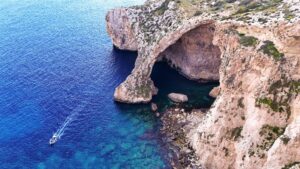
The Blue Grotto — Malta’s famous sea cave system lit by extraordinary blue light — is approximately 15 to 20 minutes from St Peter’s Pool by car and makes a natural pairing for a full south Malta day. Visit St Peter’s Pool in the morning before the crowds arrive, have lunch at Marsaxlokk, and head to the Blue Grotto in the afternoon when the sea is typically calmer and the caves are more navigable.
From 2026, our private boat tours from Marsaxlokk can cover St Peter’s Pool, the nearby lagoons, and the Blue Grotto in a single day — all from the water. Book here or contact us here.
For the complete south Malta boat tour guide including St Peter’s Pool and the Blue Grotto, check out our 3-day Malta itinerary which covers the full south Malta circuit.
What to Bring to St Peter’s Pool
There are no facilities at St Peter’s Pool. No cafe, no toilets, no showers, no changing rooms, no sun lounger hire, no kiosk — nothing. Everything you need for the day must come with you. This is not a complaint. It is precisely what keeps St Peter’s Pool feeling wild and unspoilt.
The essential packing list:
- High-factor sun cream (SPF 50+) — there is almost no natural shade. The limestone reflects the sun intensely and the UV exposure is significant
- Water shoes — the path to the pool involves uneven rocky surfaces. Non-negotiable for safe movement on wet limestone
- Plenty of drinking water — more than you think you need. The heat and the swimming will dehydrate you faster than you expect
- Food and snacks — there is nowhere to buy anything. Bring a picnic
- Hat and UV cover-up — shade is extremely limited and the sun at midday on bare limestone is intense
- Snorkelling mask and fins — this is genuinely one of the best snorkelling spots in south Malta and it would be a shame to miss the underwater world
- Waterproof phone case or underwater camera — the water clarity is remarkable and the cliff jumping photographs are extraordinary
- First aid kit basics — plasters, bandage, antihistamines. In case of rock cuts or jellyfish stings
- Cash — for the water taxi from Marsaxlokk and for parking
- Bag for your rubbish — there are no bins. The environment that makes St Peter’s Pool beautiful depends on everyone taking their rubbish home
💡 Local Tip: Go to the toilet before you arrive. There are no facilities anywhere near St Peter’s Pool. The nearest toilet is back in Marsaxlokk.
St Peter’s Pool by Private Boat — From Marsaxlokk (2026)
From 2026, organised private boat tours will depart from Marsaxlokk harbour to St Peter’s Pool and the surrounding south Malta coastline. This is the option that genuinely transforms the experience.
Arriving at St Peter’s Pool from the sea gives you a perspective that no clifftop approach can match. The horseshoe formation of the pool is clearly visible from the water — you can see its full shape, the colour gradients inside the bay, and the cliff system that creates it. More importantly, you can anchor in open water nearby and swim in near-total privacy, without the clifftop crowd.
The private boat tour also gives you access to:
- Il-Ħofra il-Kbira — the larger natural lagoon just along the coast, almost never visited and extraordinary for swimming and snorkelling
- Il-Ħofra iż-Żgħira — the smaller lagoon, even more secluded, with remarkable water clarity
- The Blue Grotto approach from the sea — the cave system illuminated from the water, which is the only way to experience it properly
- The Delimara coastline — dramatic limestone cliffs and sea formations visible only from a boat
Contact us here to enquire about private boat tours from Marsaxlokk. Available from May 2026.
Practical Tips — Getting the Most From Your Visit
Arrive Early
The difference between 09:00 and 12:00 at St Peter’s Pool in summer is dramatic. By 09:00 the pool is quiet — perhaps 10 to 15 people on the rocks, the cliff jump queue non-existent, and the water practically yours. By noon, over 100 people can be present, cars are queuing on the approach road, and the cliff jump queue is long.
If you want St Peter’s Pool at its best — go early. Set the alarm. It is worth it.
Avoid Rough Conditions
Do not jump when waves are running. The pool can look calm from the clifftop even when conditions below are more complex. If you can see white water breaking anywhere around the pool edges, if the sea beyond Delimara Point looks rough, or if the lifeguards at nearby beaches have raised a red flag — do not jump. Sit on the rocks and enjoy the scenery instead.
The rip current risk here is the same as at Golden Bay — when waves build and break against the limestone, the water has to go somewhere. It exits through the natural gaps in the pool structure, creating outward-flowing currents. The calm-looking patch of water with suppressed waves is precisely where the rip is flowing. Swim across a rip current, never against it.
Photography
St Peter’s Pool is one of the most photogenic natural swimming spots in Europe. The shots worth getting:
- Overhead/aerial — the full horseshoe shape of the pool with the turquoise water inside. Best in the morning before crowds fill the rocks
- Mid-jump cliff shot — get someone to photograph you at the moment of release from the cliff edge
- Underwater — the visibility rewards an underwater camera. The rocky bottom, the fish, and the light refracting through the surface are extraordinary
- Golden hour — the limestone glows warm amber in the late afternoon light. The pool at 18:00 in September is as beautiful as anywhere in Malta
Frequently Asked Questions — St Peter’s Pool Malta
Is it safe to swim at St Peter’s Pool Malta?
Yes — when conditions are calm. There are no lifeguards, so never swim alone and always check conditions before entering. Avoid cliff jumping when waves are running. Check the flag system at nearby beaches as a guide to overall sea conditions.
How do I get to St Peter’s Pool from Valletta?
By car — approximately 40 minutes via Marsaxlokk. By public transport — take the 81 or 85 bus to the Abdosir stop, then walk 30 to 40 minutes to the pool. The water taxi from Marsaxlokk waterfront is the most enjoyable non-car option.
How do I get from Marsaxlokk to St Peter’s Pool?
By car — 15 to 20 minutes. By water taxi from the Marsaxlokk waterfront — approximately €10 return, 20-minute journey. By foot — 30 to 40 minutes but challenging in summer heat. From 2026, by private boat tour from Marsaxlokk harbour.
Is there cliff jumping at St Peter’s Pool Malta?
Yes — multiple heights from 1 metre to approximately 7.5 metres. Always jump where you see others jumping, always check for swimmers below before jumping, and never jump in rough conditions. Aim for the bright light blue water where the depth is sufficient.
Are there facilities at St Peter’s Pool Malta?
No — no toilets, no cafes, no changing rooms, no showers, no sun loungers. Bring everything you need including plenty of water, food, sun cream, and a bag for your rubbish. A seasonal kiosk occasionally operates nearby but it cannot be relied upon.
What is near St Peter’s Pool Malta?
Marsaxlokk fishing village (15 to 20 minutes by car) for lunch and the Sunday market. Tas-Silġ Archaeological Complex (minutes away). Delimara Lighthouse and Fort. Saint Lucian Tower. The Blue Grotto (15 to 20 minutes by car). Il-Ħofra il-Kbira and Il-Ħofra iż-Żgħira natural lagoons (accessible by private boat).
Can you snorkel at St Peter’s Pool Malta?
Yes — this is one of the best snorkelling spots in south Malta. The water clarity is exceptional, the rocky reef supports diverse marine life, and there is a small cave at the western end of the bay worth exploring. Bring your own gear as there is no hire available.
What is the diving dog at St Peter’s Pool Malta?
Titti — a dog who went viral globally for jumping into the pool alongside her owner Carmelo Abela. Titti died in 2019. Her successor Tina carries on the tradition and can occasionally still be spotted at the pool demonstrating her jumping ability.
Is there a fence at St Peter’s Pool Malta?
Yes — fencing was erected around the clifftop perimeter in the last two years to prevent debris from the eroding limestone cliffs from falling into the pool below. The fence is a safety measure and does not restrict access to the pool, the jumping spots, or the rock platforms. It does slightly alter the visual character of the clifftop.
Can you do a private boat tour to St Peter’s Pool?
From 2026, yes — private boat tours from Marsaxlokk harbour will include St Peter’s Pool and the nearby lagoons. Contact us here to enquire. This is the best way to experience the pool without the clifftop crowds and to access the nearby lagoons that are almost impossible to reach from land.
What time should I arrive at St Peter’s Pool Malta?
Before 09:30 in summer. The pool is quiet before 10:00 and significantly busier by noon. By early afternoon in July and August, queues of cars can form on the approach road. Arriving early means a quieter pool, a manageable cliff jump queue, and the morning light that makes photography at St Peter’s Pool outstanding.
Book Your Private Boat Tour — St Peter’s Pool and South Malta
The finest way to experience St Peter’s Pool is from the water.
From 2026, Outdoor Explorers Malta organises private boat tours from Marsaxlokk covering St Peter’s Pool, Il-Ħofra il-Kbira, Il-Ħofra iż-Żgħira, and the Blue Grotto — all the highlights of south Malta’s extraordinary coastline in a single day, with no clifftop crowds, no queuing for parking, and no limitations on where you swim.
For the Blue Lagoon, Comino, and north Malta private boat tours departing from Cirkewwa, see all our available tours here.
👉 Contact us here to discuss the south Malta boat circuit from Marsaxlokk.