

Ramla Bay Gozo — The Complete Local Guide 2026
There are beaches in the Mediterranean that are beautiful. And then there is Ramla Bay.
A wide sweep of deep red-orange sand curving between terraced limestone hills and a valley of lush Mediterranean vegetation. Water that shifts from pale turquoise at the shoreline to deep blue at the bay’s open edge. The white statue of the Madonna standing at the centre of the beach, watching the sea as she has for over 140 years. And beneath the sand and the water — two thousand years of history that most visitors walk straight over without ever knowing it is there.
Ramla Bay is Gozo’s most famous beach — and arguably the finest beach in the entire Maltese archipelago. Known locally as Ir-Ramla l-Ħamra — the Red Sandy Beach — it is one of the only genuinely sandy beaches on an island whose coastline is predominantly dramatic limestone rock and pebble. The sand itself is extraordinary: a deep red-orange colour produced by iron-rich limestone and mineral deposits in the surrounding hills, eroded over millennia into the fine, soft grains that cover the bay today.
This guide covers everything — the history, the archaeology, the turtle nesting, the Madonna statue, the Roman villa beneath the sand, the submerged Knights wall in the water, how to get there, what to do, and the best way to see Ramla Bay from the sea on a private boat tour.
Written by a team that is on Gozo’s water every single day.
Ramla Bay Gozo — Quick Facts 2026
| Maltese Name | Ir-Ramla l-Ħamra — The Red Sandy Beach |
| Location | North coast of Gozo, between Marsalforn and San Blas Bay |
| Closest village | Xagħra |
| Sand type | Red-orange — iron-rich limestone erosion |
| Protected status | Natura 2000 / Special Area of Conservation / Blue Flag certified |
| Best time | April–June and September–October |
| Lifeguards | Present during summer months |
| Facilities | Parking (€2), sunbeds, umbrellas, kiosks, public toilets |
| Turtle nesting | Active nesting site — nests recorded every year since 2020 |
| Roman villa | Beneath the sand — excavated 1910–11, reburied |
| Underwater wall | Knights-era defensive wall submerged at the bay edge |
| Madonna statue | 1881 — dedicated to Madonna ta’ l-Isperanza |
| Calypso Cave | Clifftop viewpoint — currently closed, viewpoint open |
| Distance from Mġarr Harbour | Approximately 25 minutes by car |
| Distance from Victoria | Approximately 10 minutes by car |
What Makes Ramla Bay Unique
The Red Sand — Why It Looks Like That
The most immediately striking thing about Ramla Bay is the colour of the sand.
Most beaches in Malta and Gozo are rocky limestone — beautiful in their own way but not sandy. Ramla Bay is a genuinely rare exception. The red-orange colour comes from iron-rich limestone and mineral deposits in the surrounding hills that have been eroding for thousands of years, gradually producing the distinctive fine grains that carpet the bay today.
Depending on the sunlight — angle, time of day, and season — the sand shifts between deep terracotta, warm orange, and golden amber. In the evening light, with the limestone hills behind it and the Mediterranean in front, the colour is genuinely unlike anything else available in the Maltese islands.
In 2017, Travel and Leisure Magazine included Ramla Bay in the world’s 7 most beautiful red sandy beaches — one of the very few Mediterranean entries in that list.
The Protected Status
Ramla Bay is a Natura 2000 protected site under the EU Habitats Directive — one of Europe’s most important nature conservation designations. The bay was designated due to its extraordinary combination of ecological features: a sandy beach, different types of sand dunes, fixed dunes, inland rocks and boulder screes, and a small marshland where Wied ir-Ramla meets the sea.
Crucially, Ramla Bay contains the only intact sand dune system remaining on the Maltese Islands. This alone makes it irreplaceable — sand dunes are the primary natural defence against coastal erosion, and the dunes at Ramla Bay have been protecting the bay’s character for millennia.
The bay also holds Blue Flag certification — one of only 12 beaches in Malta and Gozo to do so — recognising its exceptional water quality, safety standards, and environmental management.
Additionally, in 2020, the bay achieved a remarkable milestone: its first recorded sea turtle nest in 70 years. More on this below.
The Turtle Nesting — An Extraordinary Annual Event
This is the detail that no other Ramla Bay guide has fully covered — and it is genuinely one of the most remarkable natural phenomena occurring at a Mediterranean beach.
Sea turtles have nested at Ramla Bay every year since 2020 — 2021, 2022, 2023, 2024, and 2025 all recorded active nests. What began as a remarkable one-off event after a 70-year absence has become an annual occurrence that reflects both the improving health of the Mediterranean marine ecosystem and the protected status of the bay.
How the Nesting Works
The turtles — loggerhead sea turtles (Caretta caretta) — come ashore exclusively at night. This is deliberate behaviour: the darkness provides protection from predators and from human disturbance. The turtles emerge from the sea after dark, move up the beach, and excavate a nest chamber in which they lay their eggs.
The nesting consistently occurs on the eastern side of the bay — the Nadur side. The reason is likely geological. The eastern section of Ramla Bay has deeper, finer sand with significantly fewer pebbles than the central and western sections. The looser sand makes nest excavation easier and provides better conditions for egg incubation — the right balance of temperature, moisture, and oxygen penetration that developing turtle eggs require.
The Volunteers
A dedicated team of volunteers monitors the turtle nesting throughout the season — walking the beach at night, protecting active nests from disturbance, and documenting each nesting event. Their work is extraordinary and largely invisible to daytime visitors. The monitoring is coordinated with the relevant Maltese environmental authorities and follows strict protocols to ensure the turtles are not disturbed during the most vulnerable phases of nesting and hatching.
If you visit Ramla Bay and see marked sections of the beach with protective barriers in summer — these mark active turtle nests. Do not approach them. Do not disturb the sand around them. The nesting is fragile and the turtles are protected under both Maltese and EU law.
What the Turtles Mean for Ramla Bay
The annual return of nesting loggerhead turtles to Ramla Bay is not just a natural curiosity. It is a signal — that the bay’s protected status is working, that the water quality is high enough to sustain a healthy marine ecosystem, and that the careful management of this beach has created conditions in which one of the Mediterranean’s most ancient animals feels safe enough to return year after year.
💡 Local Tip: If you want to see Ramla Bay at its most atmospheric — and perhaps witness turtle-related volunteer activity — visit in the early evening or at dusk in June and July. The beach empties significantly after the daytime crowds leave, and the light at that hour is extraordinary.
The Madonna Statue — 140 Years of Watching Over Sailors
Standing at the centre of Ramla Bay’s beach, on a tall pedestal, is a white statue that most visitors photograph without knowing its story.
This is the Madonna ta’ l-Isperanza — the Madonna of Hope — and she has been watching over this bay and the sea beyond it since 1881.
Who Made Her and Why
The statue was commissioned by Ganni Gauci — a police officer who was stationed at Ramla Bay as a coastal guard. Gauci made the statue with the sailors and fishermen of Gozo in mind. The men who worked the sea around these islands lived with the constant reality of the Maltese coast’s unpredictable weather — the sudden storms that could overwhelm a small boat, the channels between the islands that could turn treacherous without warning.
He named her the Madonna of Hope — Madonna ta’ l-Isperanza — because hope was what the sailors held onto when the storms came. Standing on the beach, facing the sea, holding the infant Christ on her arm, she was positioned so that anyone returning by sea would see her on the approach. She still faces the water today, as she has for 140 years.
The pedestal was built from limestone blocks most likely removed from the nearby fortification ruins along the bay.
The 1954 Marian Year
In 1954 — the Marian Year — Bishop Monsignor Giuseppi Pace granted a 100-day Indulgence to anyone who recited the Salve Regina in front of the Madonna at Ramla. The painting and restoration of the statue at this time was carried out by Mikelang Apap — later Monsignor and Canon of the Basilica of Marija Bambina in Xagħra.
During one of these restoration sessions, Don Mikelang made a disturbing discovery: beneath the layers of paint, the limestone of the original statue had been consumed by sea salt — the constant proximity to the Mediterranean had eaten into the stone itself.
The 1965 Replacement
Don Mikelang contacted the Gozitan sculptor Wistin Camilleri to assess what it would cost to make a replica of the original statue — identical in form but made from cement rather than limestone. Camilleri quoted approximately forty lira — a significant sum at the time. Frangisk Gauci, son of the original commissioner Ganni, was determined that the Madonna should be preserved and agreed to cover the cost.
In 1965, the deteriorated original was removed and replaced with the cement replica that stands at Ramla Bay today. The following year, 1966, Don Mikelang Apap dedicated a poem to the Madonna of Ramla Bay — a testament to the personal connection he had developed with this statue through years of restoration and care.
The Madonna you see at Ramla Bay today is therefore the 1965 replica — but she carries the memory and the intention of Ganni Gauci’s original 1881 commission. She is still watching the sea, still holding the hope of those who sail it.
💡 Local Tip: Walk to the right side of the bay past the Madonna statue for the section of beach with the fewest pebbles and the softest sand for entering the water. Locals have known this for generations — the area just past the statue is consistently the most comfortable entry point.
The Roman Villa Beneath the Sand
Most visitors walk the length of Ramla Bay without any idea that they are walking above one of the most significant Roman-era archaeological sites in the Maltese islands.
Buried beneath the sand dunes on the eastern side of the bay — near the Vendome Battery built by the Knights in 1715 — lie the remains of a Roman villa that was in use approximately 2,000 years ago. The site was first professionally excavated in December 1910 and through 1911 by Sir Themistocles Zammit — one of the most significant figures in Maltese archaeology, the man who also excavated the Hal Saflieni Hypogeum.
What Was Found
By the end of the 1910–11 excavations, Zammit’s team had uncovered a Roman building consisting of nineteen rooms. The villa showed evidence of extraordinary richness for its time and location:
- Decorative marbles — imported from quarries across the Roman Mediterranean
- Painted walls — fragments of fresco painting indicating a villa of significant wealth
- Sculptures — evidence of statues within the structure, though some of these have since disappeared without trace
- A water channel — evidence that the Romans specifically chose this location because the valley of Wied ir-Ramla provided reliable fresh water
The positioning of the villa reflects a sophisticated understanding of the landscape. The Romans built here because the valley provided fresh water, the bay provided access to the sea, and the surrounding hills provided shelter from the dominant north winds. It was, in the terminology of Roman archaeology, a Villa Marittima — a coastal villa designed for both agricultural and leisure use.
After excavation, the site was reburied to protect it. However, the bi-annual northerly storms that strike the Maltese islands periodically re-expose sections of the rooms closest to the shore. The archaeology exists in a delicate relationship with the sea — revealed by storms, covered by calmer periods, and perpetually threatened by the erosion that has been reshaping this coastline for millennia.
The New Discoveries — The Underwater Blocks
Between 2010 and 2017, a series of surveys by the Superintendence of Cultural Heritage confirmed something extraordinary: a set of ashlar blocks — large, precisely cut limestone blocks — had been uncovered at the water’s edge and in the shallows of Ramla Bay itself. These blocks are confirmed to form an additional part of the Roman villa complex — meaning the villa was significantly larger than the 1911 excavation suggested, and that part of it now lies beneath the water.
The villa, in other words, has been partially submerged by the sea over two millennia — the coastline has changed enough since Roman times that what was once dry land is now underwater.
The Underwater Wall — Knights of Malta Defensive Structure
Separate from the Roman villa remains, there is a submerged wall in Ramla Bay that is believed to date from the Knights of Malta period — constructed for defensive purposes to protect the bay from piratical raids.
According to Professor Anthony Bonanno of the University of Malta, who has studied the site extensively, it is very likely that the Knights used stone blocks quarried from the walls of the ancient Roman villa to construct this defensive wall. The Roman villa, in other words, provided the raw material for a medieval fortification — stones that had stood for over a thousand years repurposed for the defence of a new era.
The wall is visible from the water in certain sea conditions — particularly after storms that disturb the sandy bottom. From a boat, approaching the bay from the north, the darker line of the submerged wall is occasionally visible in the clearer water near the bay’s eastern edge.
This submerged wall is, to our knowledge, completely unmentioned in any standard Ramla Bay tourist guide. It is a genuinely hidden piece of local history that rewards the curious visitor — and the curious snorkeller.
Calypso Cave — The Myth of Odysseus
On the western clifftop above Ramla Bay sits Calypso Cave — named for the sea nymph of Greek mythology who, according to Homer’s Odyssey, kept Odysseus captive on her island for seven years after his shipwreck during a storm on his journey home from Troy.
The identification of this specific cave as the cave of Calypso is traditional rather than archaeological — Homer’s Ogygia, where Calypso lived, has been claimed by several Mediterranean locations over the centuries. However, the association between Gozo and Calypso is ancient and persistent. The Greek geographer Scylax, writing in the 4th century BC, identified the Maltese islands as Calypso’s home. The Roman writer Pseudo-Aristotle made the same identification.

Whether or not Odysseus was actually here, the view from the clifftop above the cave is one of the finest panoramic views in Gozo — the full width of Ramla Bay below, the red-orange sand visible from above, the valley of Wied ir-Ramla stretching inland, and the open Mediterranean beyond.
The cave itself is currently closed to the public for safety and structural reasons. The viewpoint above it, however, is fully accessible — and it is from this clifftop position that the most dramatic photographs of Ramla Bay from above are taken.
💡 Local Tip: The Calypso Cave viewpoint is best visited at sunrise or in the early morning before the heat builds. The light on the red sand from this angle in the early morning is extraordinary — the bay glows in a way that midday photographs completely miss.
Tal-Mixta Cave — The Other Viewpoint
On the opposite hillside from Calypso Cave, Tal-Mixta Cave offers a different and equally extraordinary perspective on Ramla Bay.
The cave is a natural limestone opening high in the hills on the eastern coast — a wide, comfortable entrance that frames the view of Ramla Bay below like a natural photograph. The cave itself is shallow and accessible without climbing equipment. The walk up from the road takes approximately 10 to 15 minutes.
The view through the cave mouth — Ramla Bay visible below, the terraced hillsides on both sides, the sea beyond — is one of the most photographed natural compositions in Gozo. It appears constantly in Gozo photography, in travel guides, and in drone footage of the island.
Early morning and late afternoon offer the best light for photography from Tal-Mixta. Arrive before other visitors if you can — the cave tends to attract people and the view is significantly better without a crowd in the frame.
For more on Tal-Mixta Cave and the walks around Ramla Bay, check out our Gozo complete guide.
The Ġgantija Temples — 5,500 Years of History Ten Minutes Away
Ten minutes by car from Ramla Bay sit the Ġgantija Temples — a UNESCO World Heritage Site and one of the oldest free-standing structures on earth.
Built between approximately 3600 and 3000 BC — over 5,500 years ago — the Ġgantija temples predate Stonehenge and the Pyramids of Giza by over a thousand years. They were built by a civilisation about whom almost nothing is known — no writing, no confirmed name, only the extraordinary precision of the massive limestone blocks they quarried, transported, and assembled on this Gozitan hilltop.
The temples’ name comes from the Maltese word ġgant — giant — reflecting the local legend that the structures were built by giants, the only explanation that ordinary people could imagine for the scale of the limestone megaliths involved.
The Ġgantija temples represent the same extraordinary tradition of megalithic construction that produced Ħaġar Qim and Mnajdra in Malta — built by the same civilisation, working in the same limestone, pursuing the same architectural vision across the archipelago. A single combined ticket covers both the temples and the Gozo Museum of Archaeology in Victoria.
Any visit to Ramla Bay deserves at least 90 minutes at the Ġgantija Temples — they are ten minutes away by car and genuinely one of the most remarkable places on earth.
Ramla Bay from the Sea — The Private Boat Perspective 
The finest way to experience Ramla Bay is from the water.
Approaching from the north by private boat — coming around the headland from Marsalforn or from the direction of Comino — the bay opens in front of you with a dramatic completeness that no clifftop viewpoint can match. The full width of the red sand is visible. The Madonna statue is visible at the centre. The limestone hills rise on both sides. The valley of Wied ir-Ramla extends inland. The blue of the water in the bay itself — shallow and vivid over the pale sandy bottom — contrasts with the deeper blue of the open sea outside it.
This is the view that the sailors coming home to Gozo would have seen. The view that Ganni Gauci’s Madonna was built to greet. The view that, on a calm day with good light, genuinely takes your breath away.
What to See Underwater at Ramla Bay
The snorkelling around the edges of Ramla Bay rewards time and patience. The central sandy area supports limited reef life — but the rocky sections at the eastern and western edges of the bay have significantly richer marine ecosystems:
- Sea bream and mullet — in loose shoals around the rocky edges
- Wrasse — bold and curious, approaching snorkellers closely
- Damselfish — in large numbers on the rocky surfaces
- Octopus — in the crevices along the bay edges, particularly on the quieter eastern side
- Sea urchins — common on the rocks; always look before placing hands or feet on any rocky surface
- The submerged wall — in calm conditions with good visibility, the line of the Knights-era defensive wall is occasionally visible as a darker shadow across the sandy bottom near the eastern edge of the bay
Gozo Coastline by Private Boat — Including Ramla Bay
Our private boat tours from Mġarr Harbour cover the full Gozo coastline — including the approach to Ramla Bay from the north, with the option to anchor in the bay for swimming and snorkelling.
The Gozo north coast is one of the least visited stretches of coastline in the Maltese islands from the sea — dramatic limestone cliffs, hidden coves, extraordinary water colour, and the peaceful atmosphere of a coast that has very little boat traffic compared to the Comino routes.
- 8-Hour Private Boat Tour with Skipper — full Gozo coastline including the north coast approach to Ramla Bay, sea caves, Mġarr ix-Xini, and more
- 6-Hour Private Boat Tour — Comino and Gozo coastline combined
- Full-Day Self-Drive Boat Rental — explore Gozo’s coastline at your own pace, no licence required
For those who want to experience the Gozo coastline at speed, the 2-Hour Jet Ski Safari covers the Gozo southwest coast including Mġarr ix-Xini, Xlendi Bay, and Dwejra — a genuinely extraordinary perspective on Gozo’s dramatic coastline from water level.
How to Get to Ramla Bay Gozo
By Car — Most Practical
From Mġarr Harbour (where the ferry from Malta arrives): approximately 25 minutes following the main road toward Victoria and then signs for Ramla Bay via Xagħra or Nadur.
From Victoria (Gozo’s capital): approximately 10 minutes.
From Marsalforn: approximately 15 minutes.
Parking is available close to the beach entrance at a cost of approximately €2 per day. In peak summer — July and August — the parking fills fast, particularly between 10:00 and 16:00. Arrive before 09:30 or after 17:00 for the most reliable parking. Additional spaces exist along the road above the beach but require a short walk down.
By Bus from Victoria
Bus Route 302 from Victoria connects to Ramla Bay. Journey approximately 20 minutes. The bus stop is called Ir-Ramla — a 10-minute walk from the beach. Public transport is affordable but in peak summer the buses can be crowded. The return journey requires checking the timetable carefully — the last bus back to Victoria runs in the early evening.
By Ferry from Malta — Then Car or Bus
The Gozo ferry from Cirkewwa in northern Malta to Mġarr Harbour takes approximately 25 minutes and runs 24 hours. Fares are charged on the return journey only — the crossing to Gozo is free. From Mġarr, take a Bolt or taxi (approximately €10 to €14) to Ramla Bay.
By Private Boat — The Most Scenic Option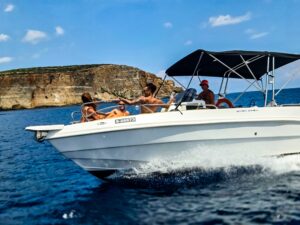
Arriving at Ramla Bay by private boat from Malta or from Mġarr Harbour gives you the full sea-level perspective of the bay — the red sand, the Madonna statue, the valley behind, and the limestone hills on both sides — in a way that no land approach can match.
Contact us here to discuss including Ramla Bay as a stop on a private Gozo boat tour.
Things to Do at Ramla Bay Gozo
Swimming
Ramla Bay is widely considered one of the best places to swim in Gozo — the gentle slope of the sandy seabed, the absence of rocks in the central section, and the generally calm conditions of the enclosed north-facing bay make it ideal for all ability levels including families with young children.
The water deepens gradually — you can wade out a significant distance and still be waist-deep. The central section is entirely sandy underfoot. The right-hand side of the bay (past the Madonna statue toward the Nadur side) has the fewest pebbles and is consistently the most comfortable entry point — a local detail that most visitors only discover by trial and error.
Lifeguards are present during the summer months, managed by the Gaia Foundation.
Snorkelling
The rocky edges of the bay — particularly the eastern section toward Nadur — reward snorkelling with a variety of Mediterranean reef species. The visibility in calm conditions is good. For more advanced snorkelling, the rocks extending around the headlands on both sides of the bay offer increasingly rich marine environments.
An insider note: In the calm, clear conditions of early morning, the outline of the submerged Knights-era defensive wall is occasionally visible in the shallow water near the eastern edge of the bay. This is one of the most genuinely remarkable hidden details at any beach in Gozo — a medieval structure lying on the sandy bottom in plain sight of thousands of visitors who never know to look for it.
Water Sports
Several kiosks at the centre of the bay offer water sports equipment rental during peak summer months:
- Kayaks and canoes
- Water skiing
- Banana rides and sofa rides

crazy sofa
- Paddle boats and SUP boards
For a more comprehensive jet ski experience covering Gozo’s spectacular coastline, the jet ski safari from Mġarr Harbour covers far more ground and far more dramatic scenery than the bay itself.
Hiking — Tal-Mixta Cave
The walk to Tal-Mixta Cave from the beach takes approximately 20 to 30 minutes depending on the route. The cave offers the most famous panoramic view of Ramla Bay from above — the full width of the beach, the red sand, the valley, and the open sea.
Stargazing
Ramla Bay is one of the best locations in Gozo for stargazing — far from the light pollution of Victoria and Marsalforn, the night sky over the bay is exceptionally clear. The Perseid Meteor Shower in August — typically peaking around the 11th to 13th — is particularly spectacular from the beach. Arriving after dark on a clear August night and watching the meteors over the open sea is one of the most extraordinary natural experiences available in Gozo.
Where to Eat Near Ramla Bay
Several small kiosks and snack bars operate at the beach during summer months — pastizzi, pizza ftira (Maltese bread sandwiches), drinks, and ice cream. The atmosphere is deliberately low-key in keeping with the bay’s protected status. There is a local kiosk next to the bus stop with good prices and local products.
For a proper meal, Xagħra village is 10 minutes away by car and has several traditional restaurants serving Gozitan food — rabbit, fresh fish, and local pasta. The village itself is worth exploring — the central square, the Ġgantija Temples on the outskirts, and the genuinely local character of a Gozitan hilltop village that has not been transformed by tourism.
Mġarr Harbour — 25 minutes away — has two consistently excellent options:
- Ta’ Tona — Some of the best pasta in Gozo, traditional Maltese menu, always busy
- Sammy’s Kitchen (Barakka) — for fresh fish from the harbour, simply prepared
For more Gozo restaurant recommendations, check out our complete 5-day Malta itinerary guide.
Best Time to Visit Ramla Bay Gozo
Spring — April to June ⭐ Recommended
The sweet spot. Weather warm and reliable (22–26°C air), sea warming toward swimable temperatures (19–24°C), and the crowds significantly thinner than summer. The vegetation in the valley behind the beach is at its most vivid green. Furthermore, spring is turtle monitoring season — the volunteers are active and the bay has a particular quiet energy.
Summer — July to August
Peak season. Water warmest (26–28°C). Beach at maximum capacity by mid-morning. Parking fills fast. Go before 09:30 or after 17:00. The evening atmosphere on the beach after the crowds leave — with the Madonna statue lit by the low sun and the valley in shadow — is genuinely extraordinary.
Autumn — September to October ⭐ Also Excellent
Water still warm (24–27°C), crowds dramatically reduced after the school holidays, and the golden autumn light that makes every photograph look extraordinary. September is consistently the best month for a first visit to Gozo — the island at its most beautiful and most manageable.
Winter — November to March
Quiet, atmospheric, and occasionally dramatic. The bay in a winter storm — waves building from the north, the red sand wet and dark, the valley green from recent rain — is completely unlike the summer experience and equally beautiful in its own way. Swimming is cold (16–18°C) but the photography and the solitude are extraordinary.
Ramla Bay vs Other Gozo Beaches
| Beach | Sand Type | Character | Best For |
|---|---|---|---|
| Ramla Bay | Red-orange sand | Large, open, popular | Swimming, families, photography |
| San Blas Bay | Red-orange sand | Small, secluded, steep access | Peace, snorkelling, adventure |
| Ħondoq ir-Rummien | Pebbles | Clear water, Comino views | Snorkelling, diving |
| Xlendi Bay | Rocky | Dramatic cliffs, restaurants | Diving, evening atmosphere |
| Mġarr ix-Xini | Rocky | Fjord-like inlet, historic | Swimming, celebrity filming location |
| Dahlet Qorrot | Pebbles | Small, quiet | Peace, local character |
For more on Gozo’s hidden beaches, check out our complete Gozo coastline guide.
Practical Tips — What to Bring to Ramla Bay
- High-factor sun cream (SPF 50+) — the beach has limited natural shade and the Maltese summer sun is intense
- Water shoes — for the rocky sections at the bay edges and for the walk to Tal-Mixta Cave
- Cash — for parking (€2), sunbed hire, kiosk food, and water sports
- Plenty of water — stay hydrated particularly in July and August
- Hat and UV cover-up — shade is limited on the beach itself
- Snorkelling mask and fins — the rocky edges reward exploration
- Camera — Ramla Bay is one of the most photogenic beaches in the Mediterranean. You will use it constantly
Frequently Asked Questions — Ramla Bay Gozo
What is Ramla Bay famous for?

Ramla Bay Gozo is famous for its distinctive red-orange sand — one of the only sandy beaches in Gozo — and for its striking natural beauty. It is also known for the Calypso Cave legend, annual sea turtle nesting, the Roman villa buried beneath its sands, and the 1881 Madonna statue at the centre of the beach.
Why is the sand red at Ramla Bay Gozo?
The distinctive red-orange colour of Ramla Bay’s sand comes from iron-rich limestone and mineral deposits in the surrounding hills that have been eroding over thousands of years. The iron content gives the sand its characteristic terracotta to amber colour depending on light conditions.
Do turtles nest at Ramla Bay Gozo?
Yes — sea turtles have nested at Ramla Bay every year since 2020, including confirmed nests in 2023, 2024, and 2025. Volunteers monitor the nesting activity throughout the season. The turtles come ashore at night and nest consistently on the eastern (Nadur) side of the bay, where the sand is deeper and the beach has fewer pebbles.
Is there a Roman villa at Ramla Bay Malta?
Yes — a Roman villa consisting of 19 rooms was excavated by Sir Temi Zammit in 1910–11. Rich in decorative marbles, painted walls, and sculptures, it was reburied after excavation to protect it. More recently, additional remains were discovered at the water’s edge and confirmed as part of the same villa complex — meaning part of it is now submerged beneath the sea.
What is the underwater wall at Ramla Bay?
A wall submerged in the bay near the eastern edge is believed to have been built by the Knights of Malta for defensive purposes — likely using stone quarried from the Roman villa. In clear, calm conditions it is occasionally visible from the water and when snorkelling.
Who made the Madonna statue at Ramla Bay?
The statue was commissioned by Ganni Gauci, a coastal police officer stationed at Ramla Bay, in 1881. It is dedicated to the Madonna ta’ l-Isperanza — the Madonna of Hope — created for the fishermen and sailors who hoped for her protection at sea. The original limestone statue deteriorated due to sea salt and was replaced in 1965 with a cement replica by Gozitan sculptor Wistin Camilleri.
Is Calypso Cave open at Ramla Bay Gozo?
The cave itself is currently closed to the public for safety reasons. The clifftop viewpoint above the cave is open and accessible — offering one of the finest panoramic views of Ramla Bay from above. The closure applies to the cave entrance, not the surrounding area.
How do I get to Ramla Bay from Malta?
Take the Gozo ferry from Cirkewwa to Mġarr Harbour (25 minutes, free to Gozo). Then drive or take a Bolt taxi to Ramla Bay — approximately 25 minutes from the harbour. Bus Route 302 from Victoria also serves Ramla Bay.
Can you do a private boat tour to Ramla Bay Gozo?
Yes — our private Gozo boat tours include the north coast approach to Ramla Bay with the option to anchor in the bay for swimming and snorkelling. The sea-level view of the red sand, the Madonna statue, and the valley behind is completely different from any land-based approach. Book here.
What is the best time to visit Ramla Bay Gozo?
September is the sweet spot — water at 24–27°C, dramatically fewer crowds than July and August, and golden autumn light. April to June is equally excellent. July and August offer the warmest water but the most crowds — arrive before 09:30 or after 17:00.
Book Your Gozo Boat Tour
The finest way to see Ramla Bay — and Gozo’s extraordinary north coast — is from the water.
- 8-Hour Private Boat Tour — full Gozo coastline with Ramla Bay approach
- 6-Hour Private Boat Tour — Comino and Gozo combined
- Full-Day Self-Drive Rental — explore Gozo’s coastline independently
- Jet Ski Safari — Gozo coastline at speed