Comino Tower (St. Mary’s Tower): Why It Was Built and Why It Still Matters
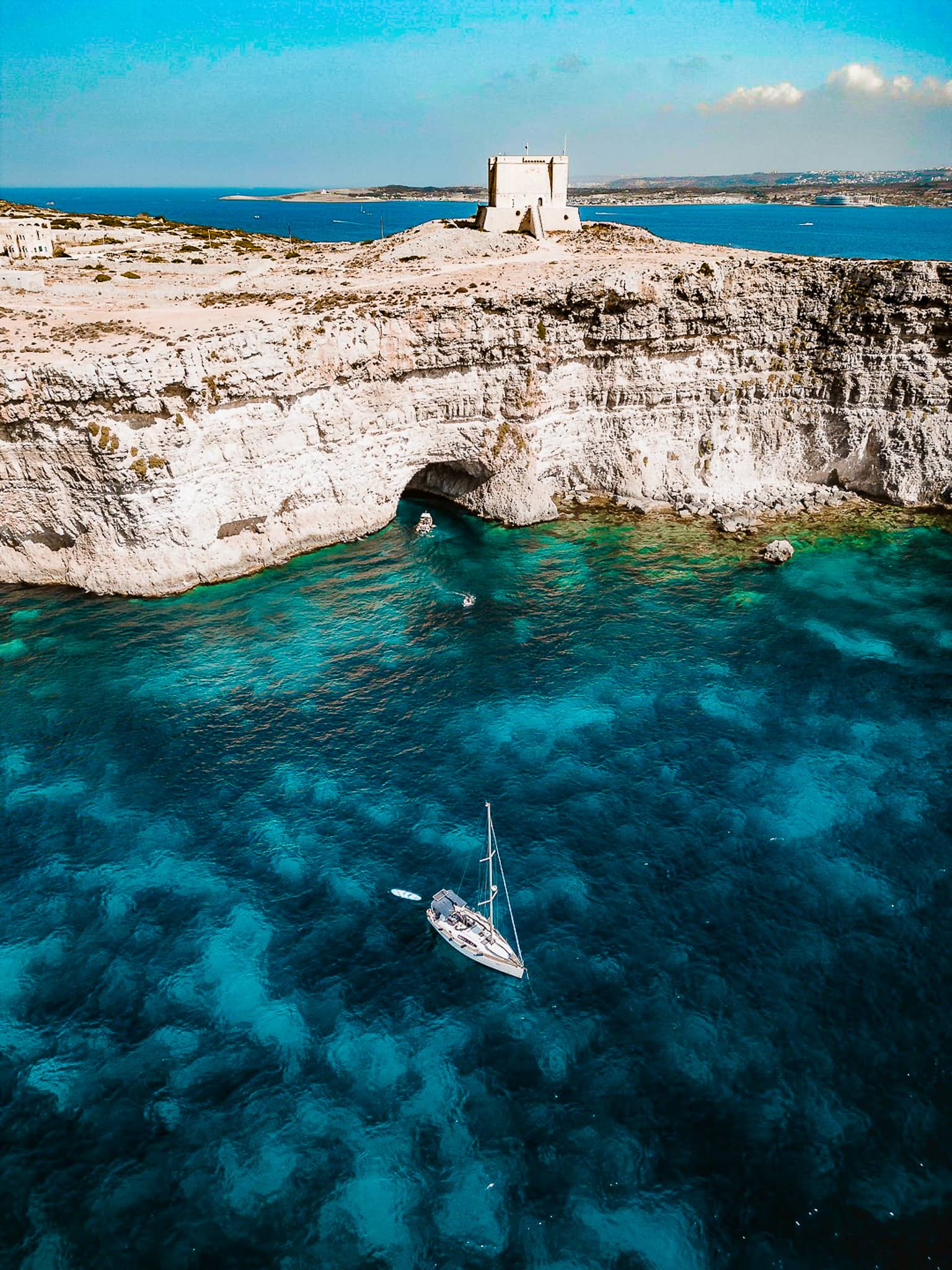
Standing on the highest point of Comino, Comino Tower, officially known as St. Mary’s Tower, was never meant to be admired quietly. It was built as a response to danger, fear, and a long history of violence at sea. Long before Comino became associated with clear water and calm anchorages, it was known as a lawless midpoint between Malta and Gozo, where boats travelled at risk and enemies moved freely.
The narrow channel below the tower was once one of the most vulnerable sea routes in the Maltese Islands. Raiders used Comino as a hidden base, striking passing vessels and retreating into sheltered coves beyond immediate reach. The tower was designed to end that threat by denying enemies shelter, controlling movement through the channel, and restoring security to the sea.
Today, when visitors approach Comino from the water, the tower still dominates the island’s skyline. Its presence explains why Comino was never developed, never settled, and never left unguarded. More than a historic structure, Comino Tower remains the key to understanding the island’s past — and why the sea has always defined it.
A Short History of Comino and Its Pirate Past
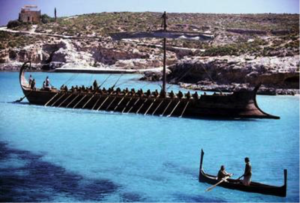
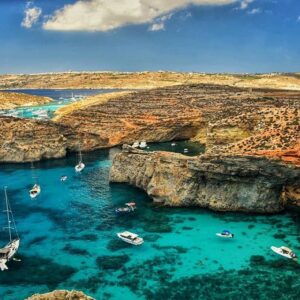
Blue Lagoon
For most of its history, Comino was never a place of safety or settlement. Lying between Malta and Gozo, the island was valued not for its land, but for its position. Whoever controlled Comino could watch, ambush, or disrupt movement through one of the most important sea channels in the Maltese Islands.
From at least the 13th century, Comino became closely associated with piracy. Turkish raiders and Barbary corsairs repeatedly used the island as a forward base, taking advantage of its isolation and rugged coastline. With no permanent population and no organised defence, Comino offered ideal conditions for concealment. Vessels could shelter in its coves during rough weather and launch sudden attacks when the sea was calm.
The narrow Malta–Gozo channel below the island was especially vulnerable. Passenger boats, supply vessels, and small merchant craft were frequent targets, often seized with little warning. Once an attack was carried out, raiders could retreat quickly to Comino, beyond the reach of any immediate response.
Because of this, Comino earned a reputation as a refuge and nesting place for enemies of the islands. It was not abandoned because it was useless, but because it was dangerous. This persistent threat eventually forced the authorities to recognise that leaving Comino undefended meant leaving the sea itself exposed — a reality that would, much later, lead to the construction of Comino Tower.
The First Failed Attempts to Defend Comino
The idea of building a tower on Comino was not new when Comino Tower was finally constructed in the 17th century. In fact, the danger posed by the island had been recognised centuries earlier. As early as 1418, the Università of Malta formally decided that a tower on Comino was essential to protect the sea route between Malta and Gozo.
The following year, the Università petitioned their sovereign, King Alfonso V, seeking royal approval for the project. Their reasoning was clear and urgent. A tower on Comino would prevent enemy vessels from sheltering on the island and launching sudden attacks on passing boats. Without it, Comino would continue to serve as a refuge and operational base for raiders who struck at will.
To strengthen their case, the Università sent one of their jurats, Giovanni Vaccaro, to Sicily to present the situation directly to the Viceroys. He warned that an attack on Gozo was likely and that delaying the tower’s construction would only invite further disaster. The Viceroys approved the plan in April 1419, but imposed a condition: the cost would be covered by a special tax of one florin on every barrel of imported wine consumed in Malta and Gozo.
The tax was imposed, and the money was collected. Yet the tower was never built. Instead, the funds were diverted into royal coffers depleted by war, and Comino remained undefended. For nearly ninety years, the tax continued to be collected, with no benefit to the islands it was meant to protect.
A second attempt followed in 1533, after Barbary corsairs landed in southern Malta, raided the countryside, and then occupied Comino for several days. The situation angered Grandmaster Philippe Villiers de L’Isle-Adam, who recognised how vulnerable Malta had become whenever the Order’s galleys were away. He ordered a military engineer to survey Comino and prepare plans for a tower. Yet once again, more pressing defensive needs elsewhere caused the project to be abandoned.
By the early 17th century, Comino had been left exposed for almost two hundred years. The threat was well understood, the solution repeatedly agreed upon — and still unrealised. It would take one decisive Grandmaster, and a personal financial commitment, to finally turn intention into stone.
Wignacourt’s Decision: The Tower That Finally Changed Comino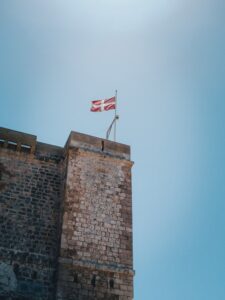
By the early 17th century, the dangers posed by Comino were no longer theoretical. Pirate activity had not ceased, and the Malta–Gozo channel remained vulnerable whenever naval patrols were absent. What had been missing for nearly two hundred years was not awareness, but decisive leadership.
That changed in 1618 under Alof de Wignacourt. Unlike his predecessors, Wignacourt did not merely acknowledge the problem — he chose to solve it personally. He recognised that Comino could only be secured if a permanent, strongly built tower denied enemies the ability to shelter, draw water, or linger in the channel.
Wignacourt proposed an ambitious plan. The island would be cleared of brushwood, brought under cultivation, and guarded by a new tower built at his own expense. The revenue generated from farming would help offset the costs of construction and maintenance, while the tower would provide protection to farmers, travellers, and vessels crossing between Malta and Gozo. In combination with the existing Garzes Tower in Gozo, the new tower would create overlapping fields of fire, effectively sealing the straits to hostile ships.
The Council of the Order unanimously approved the proposal, praising the Grandmaster’s initiative and generosity. Construction soon followed, resulting in what would become the most expensive coastal watchtower ever built in the Maltese Islands. Wignacourt spent over 18,600 scudi on its construction, armament, and provisions — a vast sum for the period.
More importantly, the tower changed Comino’s fate. For the first time, the island could be occupied and worked without constant fear. Farmers returned after nearly 180 years of abandonment, knowing that warning signals, armed guards, and a place of refuge now stood above them. Comino was no longer a lawless outpost, but a controlled and defended island — its future permanently altered by one decisive act.
Engineering a Fortress on a Deserted Island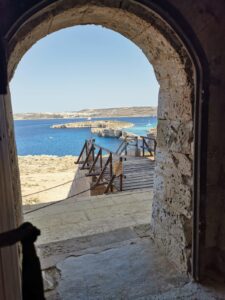
Building a major fortification on Comino was never a simple task. Unlike towers in Malta or Gozo, this structure had to function in total isolation, with no nearby settlement, no natural harbour, and no immediate support in times of attack. For that reason, Comino Tower was engineered not merely as a lookout, but as a self-sustaining fortress.
The chosen site was the highest point of a steep hill, rising around 230 feet above sea level. From here, the tower could command uninterrupted views of the Malta–Gozo channel, Mgarr Harbour, and the surrounding coastline. Elevation was critical: the higher the tower, the earlier approaching vessels could be detected, and the greater the effective range of its guns.
Rather than building directly on uneven rock, engineers first created a massive square plinth, roughly 110 feet wide and 25 feet high. This artificial platform raised the tower well above ground level, extending its visibility and making assault far more difficult. Around the plinth, the rock was deliberately cleared to form a shallow dry ditch, backed by a low glacis, counterscarp, and a fausse braye — features more commonly associated with large fortresses than coastal watchtowers. Any attacker would have been forced into exposed ground before even reaching the base.
Inside the plinth, space was left for essential storage. This included areas for animals such as horses and goats, vital for transport and sustenance, as well as storage rooms and a fresh water well. On an island with no reliable surface water, this internal well was essential for survival during long periods of isolation or siege.
Above the plinth rose the tower itself, a massive square structure with walls up to 18 feet thick. These walls were designed to absorb cannon fire and withstand prolonged bombardment. Defence was organised vertically, with multiple internal levels connected by narrow stairways, allowing defenders to control movement and retreat upward if necessary. The roof served as a gun platform, offering a full 360-degree field of fire.
Access to the tower was intentionally awkward. A detached stone ramp led to a simple but effective drawbridge, which could be withdrawn at short notice. Even more unusual was the entrance placement: it was deliberately offset rather than centred, forcing attackers into a vulnerable approach under direct fire. Every element of the design reflects the same principle — this was not a symbolic tower, but a fortress built to survive alone.
The Tower During Ottoman Threats and Military Alerts
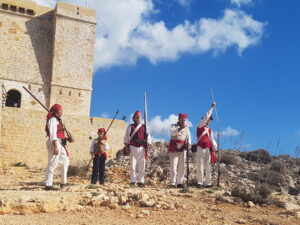
comino tower reenactment
The presence of Comino Tower took on heightened importance whenever reports emerged of Ottoman fleet movements in the central Mediterranean. From the early 17th century onwards, the Maltese Islands lived under the constant expectation of renewed invasion, and Comino sat directly in the path of any force approaching the Malta–Gozo channel.
Whenever intelligence suggested an impending threat, Comino Tower was immediately reinforced. Additional soldiers, artillerymen, and supplies were dispatched, transforming the tower from a watch post into an active defensive position. Ammunition stocks were increased, and orders were issued to ensure that each gun could sustain prolonged fire if required. At times of alert, the garrison remained on constant watch, day and night.
One such period occurred in the late 1620s and early 1630s, when reports of Ottoman naval movements prompted inspections of the towers of Gozo and Comino to assess their readiness. Similar precautions were taken again in the 1640s, when large Ottoman fleets were reported to be assembling, raising fears of retaliation against Malta. On these occasions, Comino Tower’s garrison was strengthened and its guns kept permanently manned.
The tower’s strategic value lay in its ability to act early. From its elevated roof, approaching fleets could be detected long before they reached the harbours of Gozo or the northern shores of Malta. Signals relayed from Comino allowed time for evacuation, reinforcement, and preparation across the islands. In effect, the tower served as an early warning system for the entire channel.
Even when no attack materialised, the readiness of Comino Tower was itself a deterrent. An enemy fleet attempting to pass through the channel would face immediate detection and coordinated fire from multiple directions. This constant state of preparedness explains why Comino remained guarded even when no civilians lived on the island — its importance was measured not by population, but by the control of the sea it commanded.
Watching the Channel: Signals, Guns, and Constant Readiness
From the moment it became operational, Comino Tower played an active role in the defence of the Malta–Gozo channel. It was not a passive lookout, but a working element of a coordinated warning and response system designed to detect threats early and control movement at sea.
The tower was closely linked with Garzes Tower, which guarded the approaches to Mġarr Harbour, and with signalling points in Gozo and northern Malta. From its elevated roof, Comino Tower relayed visual signals — flags by day and fires by night — allowing information about approaching vessels to move rapidly across the islands. This early warning capability often provided crucial time to prepare defences or evacuate vulnerable areas.
Artillery placement was equally deliberate. The tower’s guns covered the narrowest and most sensitive sections of the channel, particularly the approaches to Mġarr. When combined with fire from Garzes Tower, the result was overlapping coverage that made the passage of hostile ships both risky and highly visible. Even attempting to shelter along Comino’s coast or draw fresh water could expose a vessel to direct fire.
Periods of Ottoman threat placed the tower on constant alert. Reports of fleet movements triggered reinforcements, increased ammunition supplies, and round-the-clock manning. Inspections were regularly carried out to ensure readiness, and garrisons were expanded whenever an attack seemed possible.
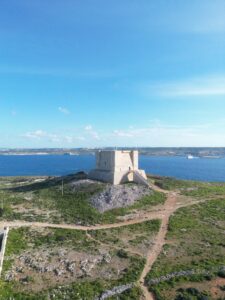
comino tower
This explains why Comino mattered even when no civilians lived there. The island’s value was never measured by population, but by control of the sea. As long as the channel remained vital, Comino Tower had to be ready — watching, signalling, and guarding a stretch of water that linked the islands together.
The Tower as a Prison: Comino in 1799
In 1798, the French invasion of Malta opened one of the most dramatic and lesser-known chapters in the history of Comino Tower. Although Comino itself was bypassed during the initial landing, the island and its tower soon became central to the internal security measures taken during the uprising against French rule.
By early 1799, Malta was in a state of siege. The French were confined within Valletta and the fortified harbours, while resistance forces controlled the countryside. Leadership of the Maltese insurgents fell to Captain Alexander Ball, who faced a growing threat not only from the enemy behind the walls, but from spies, informants, and internal subversion.
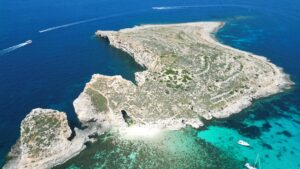
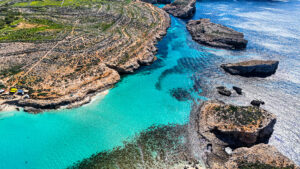
Cominotto Island from above
To contain this danger, Comino was transformed into a controlled detention zone. Suspected collaborators, spies, agitators, and other undesirable elements were exiled to the island, many confined directly within Comino Tower. Its isolation made escape extremely difficult, while the surrounding sea acted as a natural barrier. Anyone attempting to flee risked being treated as an enemy agent.
Control of access to Comino was absolute. No boat was permitted to land without explicit authorisation, and the penalty for unauthorised contact was severe. Captains who ignored orders faced death by shooting and the confiscation of their vessels — a harsh measure, but one intended to prevent rescue attempts and the spread of intelligence.
For a brief but intense period, the tower’s role shifted from coastal defence to internal control. It was no longer just watching the sea; it was holding people. Never before or since would Comino Tower play such a direct role in the political life of the islands, serving as both prison and deterrent until the French capitulated in 1800 and the crisis passed.
British Rule, Decline, and Abandonment
Following the French capitulation in 1800, control of the Maltese Islands passed firmly into British hands, and Comino Tower entered a new and very different phase of its existence. With the Royal Navy dominant in the Mediterranean, the corsair threat that had shaped centuries of defence planning gradually disappeared. The sea routes between Malta and Gozo were no longer contested in the same way, and the strategic urgency that had once defined Comino began to fade.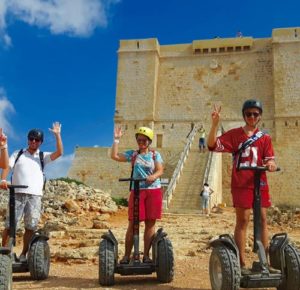
Under British administration, the tower remained in use for a time, primarily as a coast-watching and quarantine control post. Small detachments of soldiers continued to man the site, monitoring shipping and enforcing regulations, but its role was increasingly secondary. Advances in naval power and changing military doctrine made isolated watchtowers less relevant in peacetime conditions.
As the 19th century progressed, permanent guards were eventually withdrawn, and Comino Tower was left largely unattended. Without a resident garrison, the structure quickly suffered. Exposure to wind and salt air took its toll, while human neglect proved even more damaging. Stone blocks were removed, internal fittings stripped, and sections of the tower vandalised.
What had once been one of the most expensive and carefully engineered fortifications in the Maltese Islands slipped into abandonment. By the late 19th century, Comino Tower was no longer a defensive asset but a neglected relic — its strategic purpose ended, and its survival left to chance.
Damage, Vandalism, and Restoration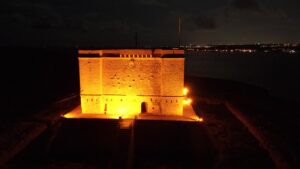
By the late 19th and early 20th centuries, Comino Tower had suffered decades of neglect. Exposed to strong winds, salt air, and seasonal storms, the stonework slowly deteriorated. Over time, deep vertical cracks appeared in the walls, likely caused by a combination of subsidence and powerful earthquakes that struck the region in 1658, 1693, 1743, and again in the early 20th century.
Human damage proved even more destructive. With no permanent guards, large stone blocks were removed from the plinth and reused elsewhere, weakening the structure. The roof parapet and parts of the corner turrets gradually disappeared, while the interior was stripped of doors, beams, and fittings. Graffiti and carved initials began to appear on the walls — some of them more than a hundred years old — silently recording the presence of visitors long after the garrison had gone.
One particularly curious feature survived until modern restoration works. To the left of the main entrance, a small dug-out space in the bastion functioned as a rudimentary toilet, carved directly into the limestone. Beneath it, a recess allowed a bucket to be placed, and beyond that, a narrow concealed passage ran through the thickness of the bastion wall. During the 2004 restoration, this hidden passage was sealed for safety reasons, but it remains one of the tower’s most intriguing details.
Serious restoration finally began in 2002, focusing on stabilising the structure and repairing the exterior, which was completed by 2004. In the years that followed, further deterioration made additional intervention necessary. Today, Comino Tower is once again undergoing restoration, with reopening planned for mid-2026. The work aims to preserve not only the tower’s structure, but the many physical traces left by centuries of use, neglect, and survival.
Life on Comino Today: One Resident, One Tower

Despite its long and often turbulent history, Comino today remains strikingly quiet. There is no village, no town centre, and no permanent community in the conventional sense. When seasonal visitors leave and the last boats depart, the island returns to a silence that has defined it for centuries.
Until relatively recently, Comino was not completely empty. As late as 2017, a small number of residents — around four people — were still living on the island. Over time, that number declined, shaped by isolation, limited services, and the practical realities of life on a remote, protected island. Today, Comino has just one permanent resident: Salvu Vella.
His home lies only a short walk from Comino Tower, in a building constructed during the British period. Originally, the structure served as a boiler room connected to the hospital facilities that once operated on Comino. Although its function has changed, its location reflects the same institutional relationship between daily life and the tower that has existed for generations.
Life on Comino is still shaped by the same forces that defined its past: weather, distance, and reliance on the sea. Supplies arrive by boat, movement depends on conditions, and modern comforts remain limited. With one resident and a single dominant landmark overlooking the island, Comino retains a rare continuity — a place where history is not just remembered, but quietly lived.