
Pirates, Prisons and Power: The Strategic Importance of Comino Between Malta and Gozo
Comino looks peaceful today.
Turquoise water. Limestone cliffs. Quiet coves where swimmers float without a care in the world.
But for centuries, this small island between Malta and Gozo was one of the most strategically important pieces of land in the central Mediterranean.
To understand Comino history, you must approach it from the sea.
As you navigate the channel between Malta and Gozo, the geography immediately explains its power. Comino sits on an exposed limestone ridge formed by block faulting north of the Great Fault. On either side of it lie two submerged valleys now filled by the sea — the North Comino Channel and the South Comino Channel.
Every vessel passing between Malta and Gozo had to cross these narrow corridors.
Whoever controlled Comino controlled the channel.
And control meant power.
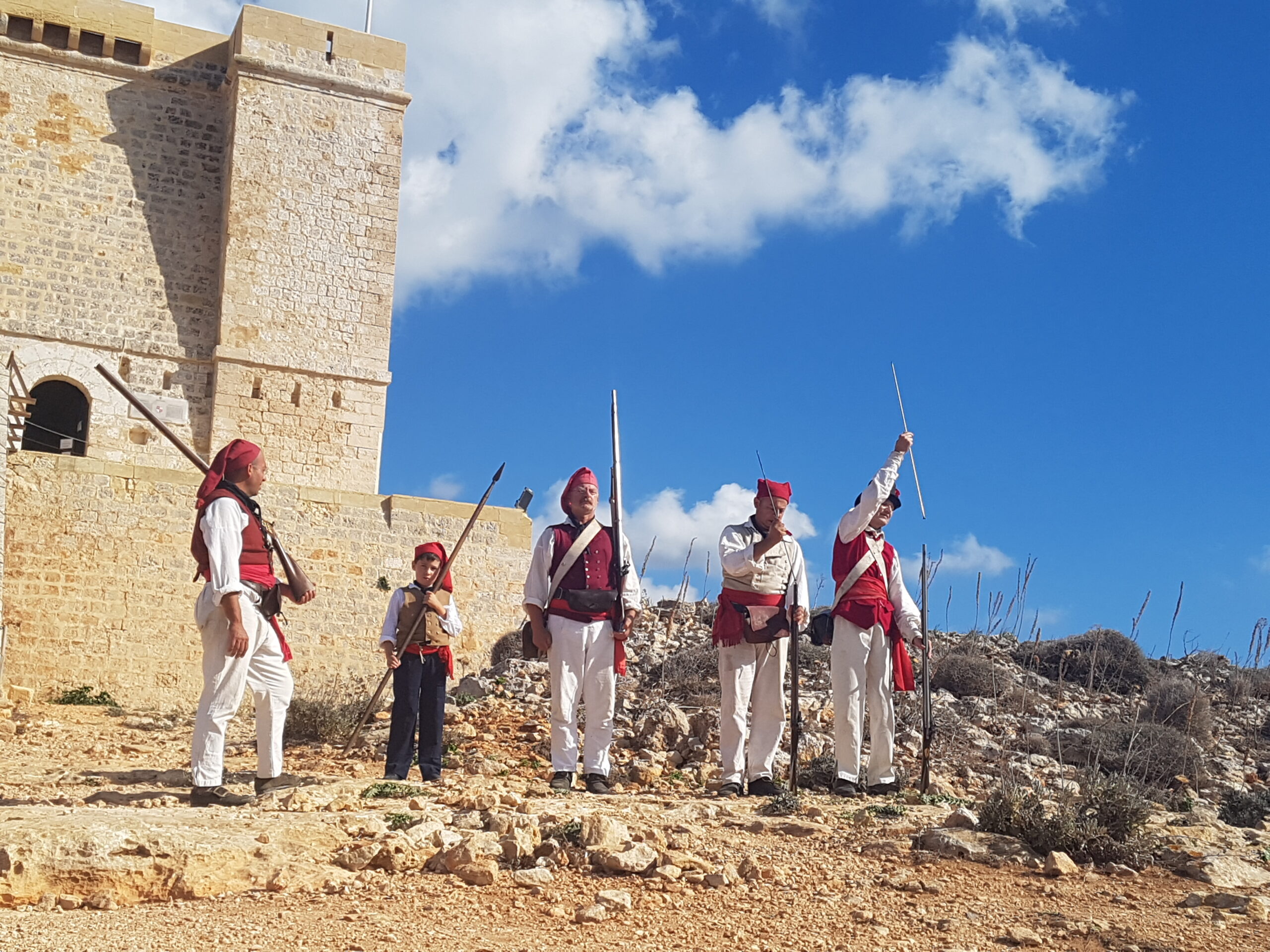
Blue Lagoon – A Hidden Inlet from the Open Sea
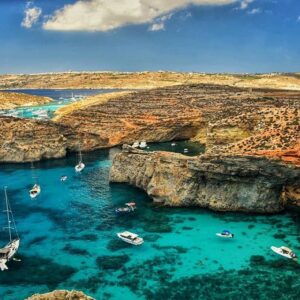
View from the Comin Tower
Today, the Blue Lagoon is known for its clear water and white sandy seabed. But from a strategic perspective, it was something far more valuable.
From the open sea, the lagoon is not fully visible. Its inner anchorage is partially concealed by land formations and by Cominotto itself. This natural visual shielding meant that vessels inside the lagoon were not easily spotted from a distance.
For pirates operating in the 17th and 18th centuries, this mattered.
A ship could anchor inside the Blue Lagoon, repair sails, divide plunder, or simply wait — largely hidden from passing vessels. It was not a wide exposed bay. It was a pocket of protection.
Even today, when you approach it slowly by boat, you notice how the lagoon only reveals itself gradually. The water shifts from deep blue to bright turquoise as you enter.
Its beauty now attracts swimmers.
But its concealment once attracted corsairs.
Crystal Lagoon – The Perfect Natural Fortress
If Blue Lagoon offered concealment, Crystal Lagoon offered defence.
Crystal Lagoon is deeper, enclosed by higher cliffs, and more dramatic in shape. From certain angles, vessels inside it would have been extremely difficult to detect from open waters.
For pirates needing stronger shelter — especially from north and east winds — Crystal Lagoon Cove provided ideal protection. The cliffs blocked prevailing winds and created calmer waters even when the surrounding sea was unsettled.
This is not accidental geography.
Comino’s coves are positioned in such a way that depending on wind direction, one side of the island always offers relative shelter. North winds? Move south. East winds? Shift west.
For sailors in wooden vessels centuries ago, that flexibility was critical.
For modern visitors on a private boat trip to Comino, it still matters — though now for comfort rather than survival.
Geography Created Opportunity
Comino’s rugged coastline is not just beautiful — it is tactical.
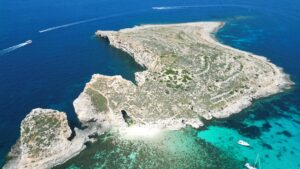
Cominotto Island, drone shot while on a Private Charter
Blue Lagoon is partially concealed from the open sea, especially when viewed from certain approaches. Cominotto and surrounding rock formations shield the inner anchorage from direct visibility. From a distance, you would not immediately see vessels anchored deep inside.
Crystal Lagoon is even more strategic.
Deeper, enclosed by higher cliffs, and protected from prevailing north and east winds, it would have offered excellent shelter for wooden sailing ships. A vessel could enter, disappear from view, and remain relatively protected even in rougher weather.
These are not random scenic features.
They are natural defensive formations.
For pirates operating in Maltese waters, Comino offered concealment, protection, and position.
Dragut and the Corsair Threat
One of the most feared figures of the 16th century Mediterranean was Dragut — known in Ottoman records as Turgut Reis.
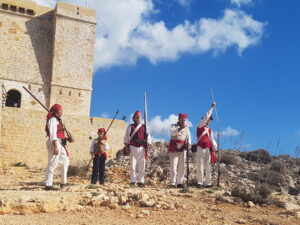
comino tower reenactment
A highly skilled corsair and later Ottoman admiral, Dragut was responsible for numerous raids across Sicily, southern Italy, North Africa, and the Maltese islands. He was not a chaotic pirate, but a disciplined naval commander operating within the Ottoman imperial strategy.
In 1551, Ottoman forces under Dragut and Sinan Pasha attacked Gozo. The island’s Cittadella fell, and thousands of inhabitants were taken into slavery. The psychological impact of this raid was immense. Malta and Gozo understood that their coastal defences were vulnerable.
While Comino was not heavily fortified at the time, its position between Malta and Gozo meant its waters were part of this wider corsair theatre.
The narrow channels were exposed trade corridors.
Ships transporting goods between the islands were vulnerable.
Hidden coves like Blue Lagoon and Crystal Lagoon would have been natural temporary anchorages for corsair vessels observing traffic or seeking shelter before moving again.
Dragut himself would later die during the Great Siege of Malta in 1565, but the type of maritime threat he represented shaped defensive planning for decades afterward.
The construction of fortified towers across Malta — including the Santa Marija Tower on Comino in 1620 — was a direct response to the same style of fast-moving corsair warfare.
Dragut symbolised the threat.
Comino symbolised the opportunity.
The Knights of St John and the Tower
By the early 17th century, the Knights of St John recognised that leaving Comino uncontrolled was dangerous.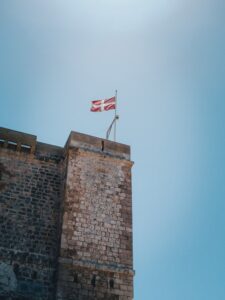
In 1618, Grand Master Alof de Wignacourt ordered the construction of a fortified tower at his own expense. Completed in 1620, the Santa Marija Tower was built on high ground approximately 230 feet above sea level.
The elevation was deliberate.
From that vantage point, guards could monitor both the North and South Comino Channels. Any fleet movement between Malta and Gozo would be visible.
The tower was heavily fortified, with thick limestone walls, corner turrets, artillery, and a surrounding defensive wall. It was not decorative — it was functional power.
Once operational, it significantly reduced the ability of corsairs to use Comino freely.
The island shifted from pirate refuge to military outpost.
Control returned to the Knights.
The Lady’s Bath – Il-Banju tas-Sinjura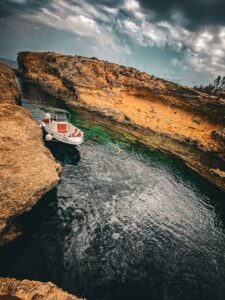
Not all of Comino’s stories are written in military records.
Near St Nicholas Bay lies a sea cave associated with the legend of Il-Banju tas-Sinjura — The Lady’s Bath.
According to local folklore, a mysterious noblewoman would descend steps carved into the rock and disappear into the cave’s waters. Whether the tale has historical basis or not, the setting makes the story believable.
The cave entrance is discreet. From outside, it blends into the coastline. Inside, light reflects in unexpected ways, and the sound of water echoes softly against limestone walls.
In an island shaped by concealment and shelter, stories of hidden encounters and secret passages feel natural.
Caves like these, scattered along Comino’s coastline, fuel the island’s aura of mystery. Narrow entrances lead into wider chambers. From the sea, they appear small — until you enter them.
Whether pirates stored treasure there will likely never be proven.
But the geography made it possible.
And that is enough for legends to survive.
Shelter from Wind, Shelter from War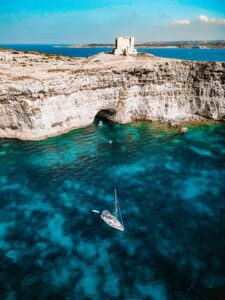
Comino’s coves are not only strategically hidden — they are functionally protected.
Blue Lagoon and Crystal Lagoon both offer natural shelter from north and east winds. For centuries, sailors relied on reading wind direction to survive.
If the north wind strengthened, the southern side of the island offered calmer waters. If the east wind blew, western coves provided refuge.
This adaptability made Comino valuable in unpredictable Mediterranean conditions.
The same shelter that once protected corsair ships now creates ideal swimming conditions for visitors.
The function changed.
The geography did not.
Pirates in the Central Mediterranean
During the 17th and 18th centuries, the central Mediterranean was a hotspot of piracy.
Barbary corsairs from Algiers and Tunis operated across North African and Maltese waters. Merchant ships transporting goods between Europe and the Levant were constant targets.
Malta, governed by the Knights of St John, was itself deeply involved in maritime warfare. The Knights operated as privateers, targeting Ottoman shipping while simultaneously defending Christian trade routes.
This created a maritime cat-and-mouse game.
Corsairs sought refuge.
The Knights pursued them.
And Comino sat directly between the conflict.
With its caves, hidden inlets, and visual cover from open sea, Comino became a natural hideout.
Local folklore still speaks of treasure hidden within sea caves. While no confirmed pirate treasure has ever been recovered, the legends persist — fuelled by the island’s geography and isolation.
When you explore the caves today, the acoustics alone hint at secrecy. Sound echoes. Light flickers across rock walls. Narrow passages open into chambers that feel detached from the outside world.
It is easy to imagine ships anchored silently inside, waiting for nightfall.
The Tower That Reclaimed the Channel
The Knights understood that leaving Comino uncontrolled was dangerous.
In 1618, Grand Master Alof de Wignacourt decided to build a fortified tower on the island at his own expense. Completed in 1620, the Santa Marija Tower was constructed on high ground approximately 230 feet above sea level.
The location was strategic brilliance.
From that elevation, guards could observe both the North and South Comino Channels. Any movement between Malta and Gozo was visible. Any suspicious anchoring within Blue Lagoon or Crystal Lagoon could be monitored.
The tower was heavily fortified, with thick limestone walls, corner turrets, and artillery. At one point, it housed cannon and a garrison strong enough to deter opportunistic raids.
Its presence changed everything.
Pirates could no longer operate comfortably under watchful eyes.
The channel was reclaimed.
From Military Stronghold to Prison
As piracy decreased, the tower’s function evolved.
Its isolation made it ideal not only for defence, but for confinement.
Unruly knights were sent there as punishment. During the uprising against French occupation in 1799, the tower was used to detain suspected collaborators. Later, during British rule, it served as a control post against smuggling and quarantine breaches.
Even prisoners of war were held there during the First World War.
The sea surrounding the tower was the ultimate barrier.
Escape meant swimming through open channel waters — an almost impossible task.
Comino remained a place of control long after the era of pirates ended.
Decline and Restoration
By the late 20th century, the tower had deteriorated significantly. Weather damage, vandalism, and structural decay threatened its survival.
Restoration efforts began in the early 2000s, stabilising the structure and preserving its historical character.
Today, the tower is under the guardianship of Din l-Art Ħelwa (National Trust of Malta). Further renovation works are ongoing, with the structure expected to be fully accessible again by 2026.
The tower that once guarded against corsairs is now being preserved as a national heritage site.
Its role has changed — but its presence still defines the skyline of Comino.
Shelter, Power and Geography
Comino’s importance was never about size.
It was about positioning.
Between two islands.
>Between two channels.
>Between open sea and protected lagoon.
>Between exposure and concealment.
Its coves provided shelter from north and east winds — a crucial advantage for wooden sailing vessels centuries ago.
Its hidden anchorages allowed pirates to evade detection.
Its elevated ridge allowed soldiers to monitor maritime movement.
Geography created power.
And Comino’s geography has not changed.
Frequently Asked Questions About Comino, Blue Lagoon & Private Boat Trips
Is Comino safe to visit today?
Yes, Comino is very safe to visit.
It is one of the most popular swimming destinations in Malta, with regular boat traffic and seasonal monitoring of swimming areas. The island itself has no permanent large population, and most visits are day trips.
Safety mainly depends on sea conditions, sun exposure, and boat traffic. When visiting on a private boat trip to Comino, a licensed skipper selects protected anchoring zones and adjusts the route based on wind direction and conditions, making the experience even safer and more comfortable.
Are there pirates in Malta today?
No. Piracy in Malta ended centuries ago.
During the 16th and 17th centuries, Maltese waters were active with Barbary corsairs, including figures such as Dragut (Turgut Reis). Today, Malta is a modern European country with strong maritime security. Pirates are now part of Comino history — not present-day reality.
Why was Comino important in history?
Comino was strategically important because it sits between Malta and Gozo, dividing the North and South Comino Channels. Any vessel travelling between the two islands had to pass close to Comino.
Its hidden coves, including Blue Lagoon and Crystal Lagoon, provided natural shelter from north and east winds. This made it valuable for pirates seeking refuge and later for the Knights of St John, who built Comino Tower in 1620 to monitor maritime movement and protect trade routes.
Did pirates really use Blue Lagoon and Crystal Lagoon?
Historical records confirm corsair activity in Maltese waters during the 16th and 17th centuries.
Blue Lagoon is partially concealed from the open sea, especially from certain approaches. Crystal Lagoon is deeper, enclosed by high cliffs, and naturally sheltered from prevailing winds. These features would have made both coves ideal temporary refuge points for vessels avoiding detection or seeking protection.
Today, those same features make them perfect for swimming and snorkelling.
Was Dragut connected to Comino?
Dragut was a major Ottoman corsair active in Maltese waters in the 16th century. He played a key role in the 1551 raid on Gozo and later died during the Great Siege of Malta in 1565.
While there is no direct record of Dragut being stationed specifically on Comino, the waters around the island were part of the wider corsair operating zone. His campaigns exposed the vulnerability of the Maltese islands and influenced later defensive structures, including Comino Tower.
Can you visit Comino Tower today?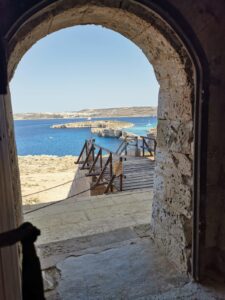
Comino Tower is currently under restoration and conservation managed by Din l-Art Ħelwa (National Trust of Malta). Works are ongoing, and broader access is expected to improve by 2026.
Even when interior access is limited, the tower remains a striking landmark visible from the sea and from Santa Marija Bay.
How do you get to Comino?
There are several ways to reach Comino:
-
Public ferry services from Malta or Gozo
-
Large group boat tours
-
Self-drive boat rentals
-
Jet ski tours
-
A private boat trip to Comino with skipper
Ferries are the most budget-friendly option but operate on fixed schedules and arrive at busy shoreline areas.
A private boat tour Malta experience allows flexible routing, access to caves, quieter swimming zones, and a tailored experience away from mass tourism.
Is Blue Lagoon crowded?
During peak summer months, shoreline areas of Blue Lagoon can become busy, especially around ferry drop-off points.
However, when visiting by private boat, you can anchor close to the swimming zone but away from the most congested sections — often nearer to Cominotto where the water is clearer and less crowded.
Positioning and timing make a major difference.
Is Crystal Lagoon better than Blue Lagoon?
They offer different experiences.
Blue Lagoon has a sandy seabed and bright turquoise water, ideal for relaxed swimming.
Crystal Lagoon is deeper, surrounded by higher cliffs, and often quieter. It offers excellent snorkelling and historically provided better shelter from north and east winds.
Many visitors choose a private boat trip to Comino specifically to experience both lagoons in one trip.
Can you see pirate caves in Comino today?
Yes.
Many sea caves around Comino can be explored by boat, depending on sea conditions. These caves, especially around Crystal Lagoon and Santa Marija Bay, reflect the type of hidden anchorages historically used for shelter.
While there are no official “pirate cave” signs, the geography that once made them useful still exists.
They are best explored by private boat.
Is Comino good for families?
Yes.
Blue Lagoon and Santa Marija Bay offer shallow, sandy areas suitable for families. When visiting by private boat, the skipper selects calm anchoring zones and adjusts the pace of the trip for comfort and safety.
Private tours also avoid the stress of crowded ferry boarding and long walks in the sun.
What is the best way to explore Comino?
The best way to explore Comino is from the sea.
The island’s strategic geography, hidden caves, sheltered lagoons, and historical landmarks such as Comino Tower are best understood by boat. A private boat trip to Comino allows you to move between Blue Lagoon, Crystal Lagoon, and surrounding coves at your own pace, away from fixed schedules.
Is a private boat trip to Comino worth it?
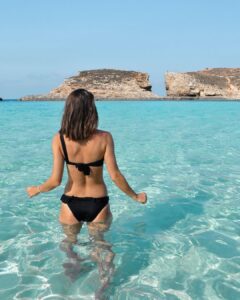
Blue Lagoon Comino
For visitors who value flexibility, privacy, and access to better swimming zones, yes.
Unlike ferries or large group tours, a private boat allows you to anchor away from crowded shorelines, explore caves safely, adjust timing throughout the day, and experience Comino as it was historically approached — from the sea.
Experiencing Comino from the Sea Today
The difference today is not in the landscape.
It is in the purpose.
Where pirates once hid ships in Crystal Lagoon, swimmers now dive into deep blue water.
Where corsairs sheltered from north winds, families now anchor comfortably in calm conditions.
Where soldiers once scanned the horizon for enemy sails, visitors now admire panoramic views from restored fortifications.
The best way to understand Comino history is still from the sea.
Because from land, Comino feels small.
From the water, it feels strategic.
When you approach Blue Lagoon slowly, watching the water change colour, you understand how easily a ship could remain hidden.
When you enter Crystal Lagoon and see the cliffs rise around you, you understand why it was defensible.
When you look up at the tower from below, you understand how completely it controlled the channel.
Comino was never random.
Comino was never random.
It was deliberate.
And the only way to fully appreciate that balance of pirates, prisons and power is to experience it from the same perspective that defined its history — from the deck of a boat moving through the channel between Malta and Gozo.
Today, instead of guarding against corsairs, you can move freely through these same waters, explore the hidden coves of Blue Lagoon and Crystal Lagoon, and see the tower rise above the cliffs just as sailors once did centuries ago.
If you want to understand Comino properly — not just visit it — the experience begins at sea.
Check Availability